
Quick Take:
What does it mean to pour your heart into raising a child to know the Lord while believing their eternal destiny may already be fixed beyond your prayers, teaching, or love?
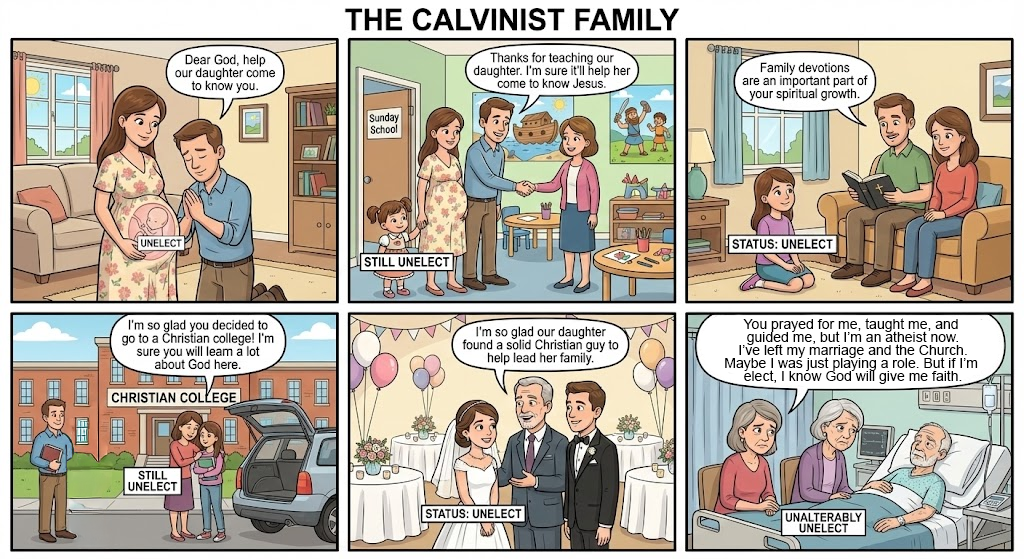
As this illustration came together, the weight of that question felt heavy. Scripture calls parents to love the Lord and to teach their children diligently, from morning to night, encouraging them again and again to know Him for themselves (Deuteronomy 6:4–9). Like many parents, we pray for our children even before they are born, support their involvement in the church, practice family devotions, encourage wise paths forward, and entrust their future relationships to God’s care. Yet within Calvinism, if a child ultimately walks away from the faith, the final explanation does not rest in their response to that love and instruction, but in God’s prior decision not to elect them. That conclusion is deeply painful, especially when Scripture tells us that God’s love exceeds even the fierce, self sacrificing love parents have for their children. The image presses whether a system that locates the ultimate reason for a child’s lostness in an eternal decree can be reconciled with the biblical picture of God’s earnest invitations, patient pursuit, and genuine desire for His children to live.
Is it an accurate picture of Calvinism?
The aim of this illustration is accuracy rather than accusation. It asks whether the picture faithfully reflects how Calvinist theology understands parenting, divine decree, and salvation when those commitments are held together. The issue is not the sincerity of parents, but the theological meaning assigned to their efforts.
Parental Faithfulness: Panels one through five depict actions that Calvinist parents sincerely and rightly take. Parents pray for their children, teach them Scripture, practice family devotions, encourage involvement in the church, support Christian education, and hope for marriages that strengthen faith. These actions align with biblical commands and reflect a genuine sense of responsibility for a child’s spiritual good (Deuteronomy 6:4–9; Proverbs 22:6).
Doctrinal Limitation: Within Calvinism, however, none of these parental efforts are understood to play a decisive role in a child coming to saving faith. While they may be instruments God uses, they have no intrinsic ability to move a child toward salvation apart from an eternal decree already fixed. Election, not parenting, ultimately determines the outcome (Romans 9:11–16; John 1:12–13).
Fixed Outcome: The illustration reflects the Calvinist claim that God’s decree, made before the foundation of the world, is the sole determining factor in salvation. A child’s final state is settled not by response to teaching, prayer, or love, but by whether they are elect. This parallels the common question about evangelism in Calvinism and extends it to the parental relationship (Ephesians 1:4–5; Acts 13:48).
Instrumental Obedience: Parenting, like evangelism, is often framed as obedience to command rather than participation in a genuinely open process. Parents act faithfully because God commands them to do so, even though the outcome is not contingent on those actions. The illustration presses whether this reduces the parenting journey to formality rather than meaningful influence (1 Corinthians 3:6–7).
Divine Character: Scripture consistently portrays God as genuinely loving every image bearer and desiring their restoration. The concern raised is whether a system that locates the ultimate reason for a child’s lostness in an eternal decree can be reconciled with God’s expressed grief, patience, and invitations to repentance (Ezekiel 18:23; Ezekiel 33:11; 1 Timothy 2:4; 2 Peter 3:9).
Taken together, the illustration does not accuse Calvinist parents of indifference or hypocrisy. It portrays a theology in which parental love, prayer, and instruction are real but ultimately non decisive, while the determining factor lies entirely outside the parent child relationship.
The question left for reflection is whether a framework that renders a parent’s deepest spiritual hopes dependent on a prior decree rather than a child’s real response is one that parents can faithfully and meaningfully live within.