
Quick Take:
What happens when the selective mercy taught in a creed is visualized in a concrete story?
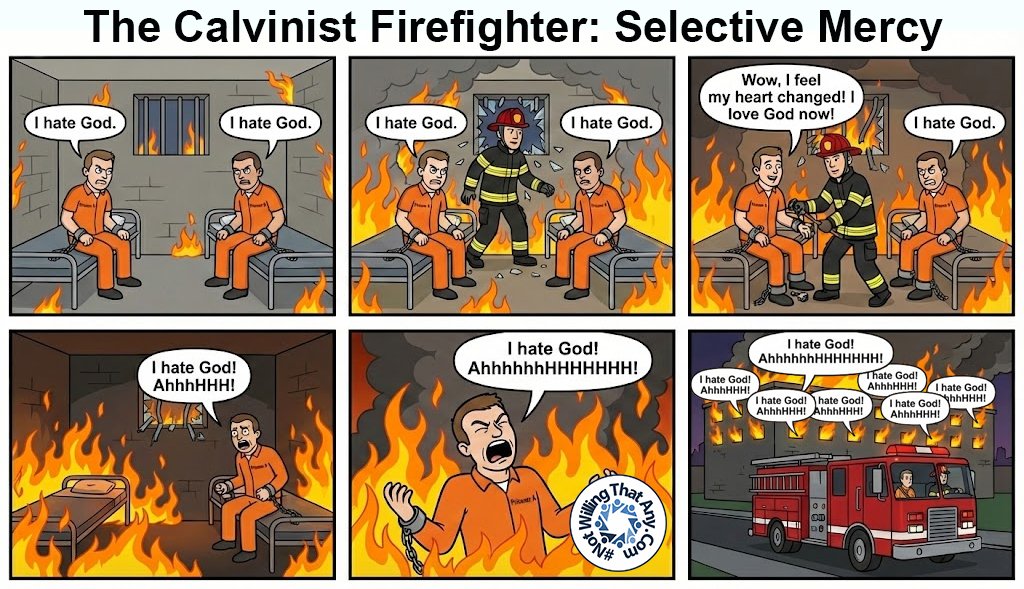
This illustration takes core Calvinist claims about total depravity, irresistible grace, and unconditional election and places them into a single scene where two sinners are identical in words and posture, yet only one receives a decisive, heart-changing rescue. By stripping away abstractions and showing selective mercy at work, the image invites the viewer to think carefully about whether this portrayal faithfully reflects the system’s teaching, and whether the moral and relational implications of that mercy look the same when seen, rather than merely stated.
Is it an accurate picture of Calvinism?
This image is not meant to caricature Calvinism but to visualize its internal logic as clearly as possible: two sinners, identical in words and disposition, are both truly hostile toward God, yet only one is rescued and inwardly transformed, emphasizing that the distinction is not found in human response but in divine choice (Romans 3:10–12).
Total Depravity and Moral Inability.
Both prisoners repeatedly say “I hate God,” underscoring the Calvinist teaching that fallen humanity is not morally neutral but actively opposed to God and incapable of turning to Him apart from grace (Romans 8:7). The chains and fire reinforce the idea that sinners are unable to free themselves or desire rescue on their own.
Irresistible Grace and Regeneration.
The firefighter’s unilateral decision to free Prisoner A illustrates the Calvinist belief that saving grace is not merely offered but effectual, producing a real and immediate change of heart (Ezekiel 36:26; John 6:37). Prisoner A’s sudden love for God is not portrayed as a response to persuasion but as the result of an inward transformation initiated entirely by the rescuer.
Unconditional Election and Selective Mercy.
Prisoner B’s continued hostility, even as judgment intensifies, reflects the Calvinist view that God is not obligated to extend regenerating grace to all and that mercy, by definition, is selective rather than universal (Romans 9:15–18). The firefighter’s departure with only one prisoner highlights that the difference between salvation and destruction rests in God’s choosing, not in human willingness.
If this illustration accurately represents Calvinist theology, it invites sober reflection on whether selective, unilateral rescue from identical sinners aligns with the full biblical portrait of God’s justice, mercy, and stated desire that the lost turn and live (Ezekiel 18:23; 2 Peter 3:9). Can you accept this visualized image of selective mercy?