
Quick Take:
What if love, belonging, and rescue depended entirely on whether you were chosen?
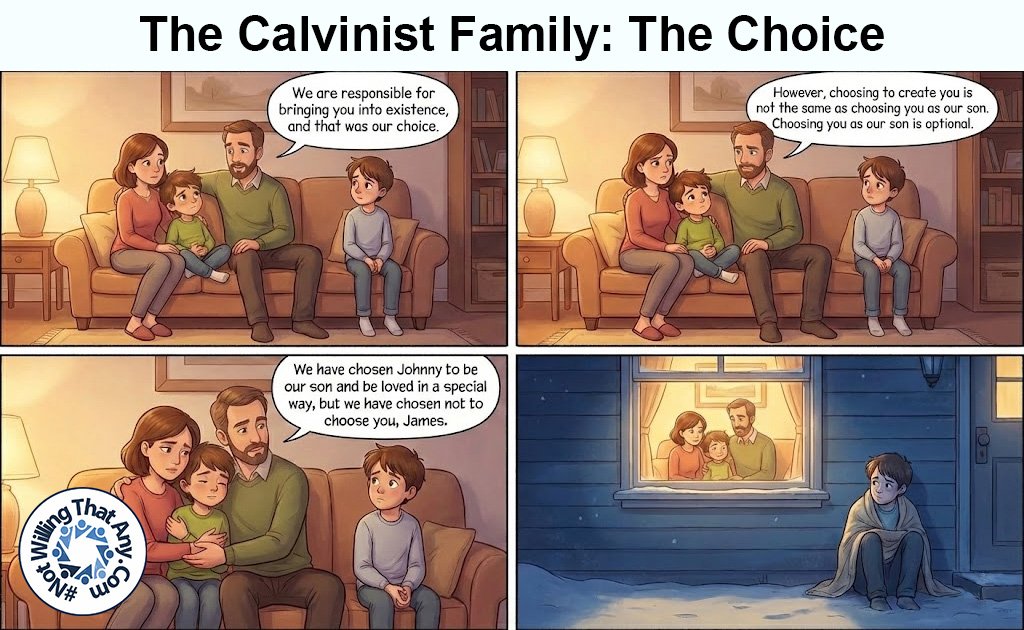
This illustration presses on a core Calvinist claim by showing a difference between creating someone and choosing them. The parents willingly bring both boys into existence, but only one is chosen to be a son in a special, saving way. James is not punished for rejecting love. He is excluded because he was never chosen. The final image lets the result speak for itself.
Is it an accurate picture of Calvinism?
At its core, this illustration is trying to present Calvinism clearly, not unfairly. The parents are not confused, angry, or inconsistent. They are acting in a way that fits the internal logic of Calvinist theology. The tension in the story does not come from emotional cruelty, but from doctrinal commitment. In that sense, the illustration aims to reflect Calvinism honestly.
1. Existence does not imply saving relationship (Creation vs Election)
In the first panels, the parents separate the act of creating a child from the act of choosing that child as a son. This reflects the Calvinist belief that God is the source of all life, yet only some are chosen for salvation. God may create many without electing them. Calvinists often appeal to passages like Romans 9:21–22, where the potter has authority over the clay to make different vessels for different purposes, and John 1:12–13, which distinguishes between being born into the world and being born of God as His children. Creation establishes existence, but election establishes saving relationship.
2. Sonship and saving love are optional, not owed (Unconditional Election)
When the parents say that choosing a child as a son is optional, they reflect the Calvinist claim that God is not obligated to save anyone. Election is not based on faith, effort, or desire, but on God’s will alone. Johnny is chosen because the parents decide to choose him. James is not chosen, not because he refuses them, but because they choose not to choose him. Calvinists commonly ground this idea in Romans 9:11–16, which says God’s purpose in election stands apart from human will or works, and Ephesians 1:4–5, where God chooses some for adoption according to the purpose of His will.
3. Special love is selective, not shared equally (Particular Love)
In the third panel, the parents openly say that Johnny is loved in a special way. James is present and hears this distinction. This reflects the Calvinist belief that God has a particular, saving love for the elect that He does not extend to the unelect in the same way. While God may show kindness or patience toward all, saving love is focused. Calvinists often point to John 10:14–15, where Jesus lays down His life for the sheep, Matthew 1:21, which says He will save His people from their sins, and Ephesians 5:25, where Christ gives Himself for the church. These passages are understood to describe a love that saves some, not all.
4. Separation is the result of non-election, not rejection (Passing Over)
The final panel shows James outside, cold and alone, without explanation or protest. This reflects the Calvinist teaching that the unelect are passed over rather than actively invited and then turned away. Calvinists often appeal to Romans 9:18, which says God has mercy on whom He wills and hardens whom He wills, 1 Peter 2:8, which speaks of those who stumble as they were destined to do, and John 6:37 and 6:44, which teach that only those given and drawn by the Father will come to the Son.
This illustration does not accuse Calvinists of lacking compassion. It shows what Calvinist doctrine produces when followed consistently. If this is an accurate picture of Calvinism, the question is not whether God has the right to choose, but whether this picture of God’s love, choice, and exclusion is one you believe Scripture teaches, and one you are willing to affirm.