
Quick Take:
If God truly reveals Himself through creation, conscience, Scripture, Christ, and the Spirit, what role are those revelations meant to play in a person’s response?
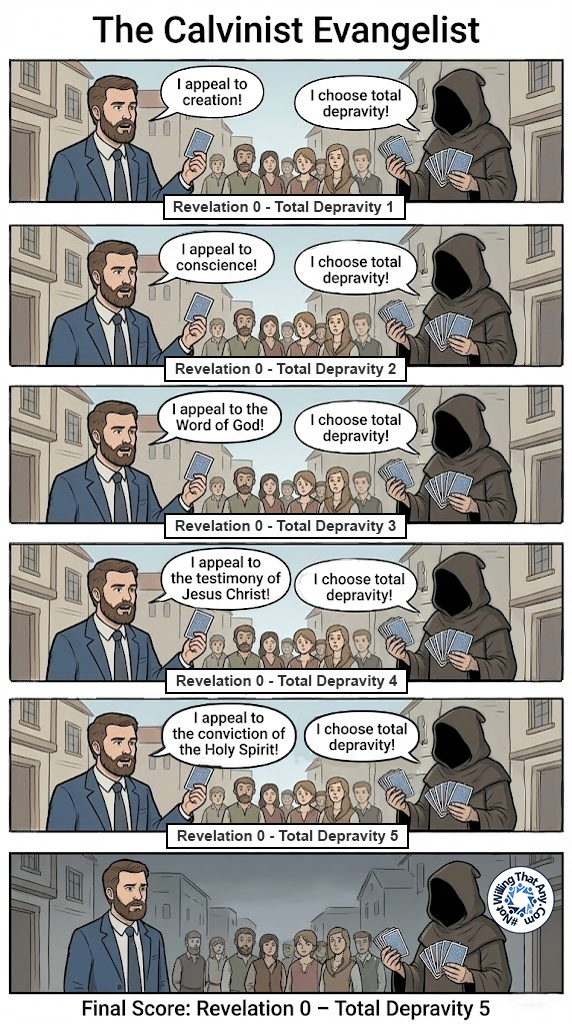
This illustration presses the central point of contention that, within Calvinism, every form of divine revelation is ultimately rendered ineffective unless total depravity is first overcome by a separate, selective act of grace. Creation, conscience, Scripture, the testimony of Jesus, and even the conviction of the Holy Spirit are portrayed as genuine appeals, yet each is dismissed as incapable of eliciting a real response from the unbeliever. The critique is not that these forms of revelation are false, but that the system treats them as powerless by design, leaving total depravity as the decisive factor every time. This stands in tension with Scripture’s repeated claims that God’s revelation truly reaches people and holds them responsible for their response, that what may be known about God is plain to them (Romans 1:18–20), that the law is written on the heart (Romans 2:14–15), that Jesus speaks so that people may believe (John 20:31), that the Spirit convicts the world (John 16:8), and that God genuinely calls people to respond (Acts 17:30; 2 Peter 3:9). The illustration invites reflection on whether revelation is intended to function as a real means by which God draws people to Himself, or merely as a formal gesture overridden in advance by an inability revelation itself can never address.
Is it an accurate picture of Calvinism?
The aim of this illustration is accuracy, not exaggeration. It is meant to show what Calvinist theology itself requires if its claims about total depravity, regeneration, and faith are taken seriously. The question is not whether the picture feels severe, but whether it faithfully represents the system.
Moral Inability: Total depravity in Calvinism refers to an inability to respond savingly to God, not merely a bent toward sin. The unregenerate person can hear and understand revelation, yet cannot respond in faith apart from grace. Revelation reaches the mind but cannot move the will (Romans 8:7–8; 1 Corinthians 2:14). The illustration reflects this by showing repeated appeals that never produce faith.
Means of Revelation: Revelation is real, true, and sincere, yet insufficient without regeneration. Creation, conscience, Scripture, and Christ’s words genuinely testify, but none can overcome depravity on their own. Drawing or teaching does not equal enabling (John 6:44; Romans 1:18–20). The illustration shows revelation present but non-decisive.
Decisive Depravity: In Calvinist theology, depravity is not gradually weakened by increased light. It remains fully effective until God removes it by a unilateral act of grace. No accumulation of revelation alters the outcome (Ephesians 2:1–3). The illustration captures this by allowing depravity to prevail every time.
Regeneration Order: Faith follows regeneration rather than producing it. Spiritual life must come before belief, which means revelation cannot function as a genuine point of response for the unregenerate heart (Ephesians 2:4–5; John 1:12–13). The illustration mirrors this order by showing revelation always failing unless something else intervenes.
System Coherence: The theology itself requires this outcome. If revelation could elicit faith prior to regeneration, total depravity as Calvinism defines it would be compromised. The illustration simply makes visible the internal logic of the system rather than extending it beyond its own claims (Romans 9:16).
Taken together, the illustration does not claim Calvinists deny revelation or sincerity. It shows that within Calvinism, all revelation is necessarily non-decisive unless preceded by regenerating grace.
That leaves a question: if this is an accurate picture of Calvinist theology, is it one you can accept?