
Quick Take:
If you invite someone who is unable to respond, is it still an invitation… really?
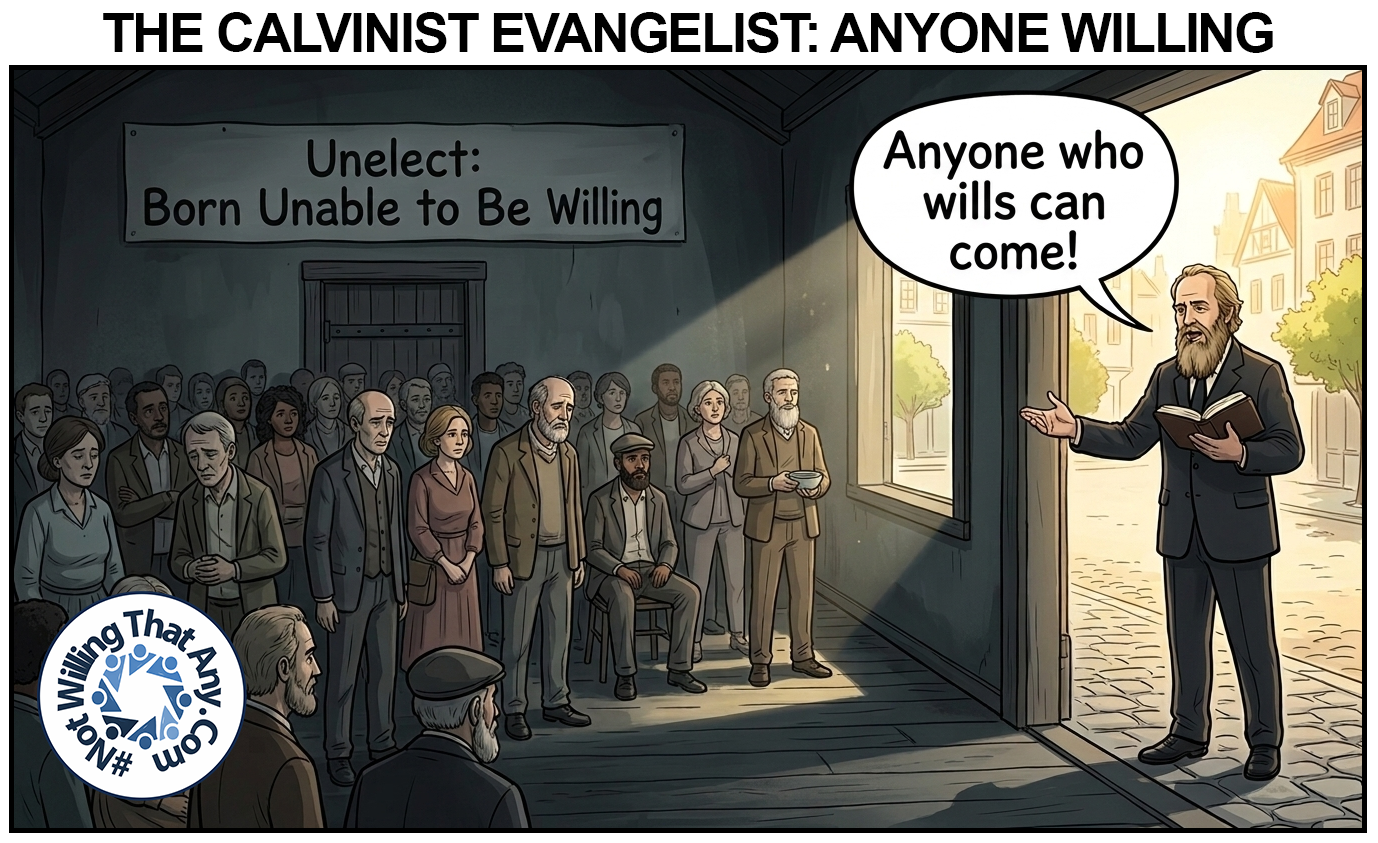
The evangelist sincerely calls out, “Anyone who wills can come!” but the people inside the room are labeled as being “born unable to be willing.” The point of the illustration is not to mock Calvinist evangelism, but to ask a question: if people truly cannot will to come because of their condition from birth, how can the invitation meaningfully apply to them? It raises the issue of whether human responsibility can be clearly understood if the ability to respond is absent.
Is it an accurate picture of Calvinism?
This image is best understood as an attempt to visualize a theological tension rather than ridicule a position. Calvinists strongly affirm evangelism and the universal call of the gospel. At the same time, they also teach that fallen humanity is born in a condition where it cannot come to God apart from divine intervention. The illustration simply places those two claims side by side and asks whether they fit together coherently.
Total Depravity: Inability to Come
The sign in the room, “Born Unable to Be Willing,” reflects the Calvinist doctrine of Total Depravity, particularly the idea of moral inability. Calvinists often appeal to passages such as John 6:44, where Jesus says, “No one can come to me unless the Father who sent me draws him,” and Romans 8:7–8, which says the mind set on the flesh “does not submit to God’s law; indeed, it cannot.” In this view, people inside the room represent humanity in its natural state. The darkness symbolizes spiritual inability apart from grace.
Unconditional Election: Not Everyone Is Drawn
The people inside the room are labeled “unelect,” which corresponds to the Calvinist doctrine of Unconditional Election. Calvinists argue that God chooses certain individuals for salvation before the foundation of the world (Ephesians 1:4–5; Romans 9:15–16). In the illustration, this means that some in the room will eventually be given the grace that enables them to respond, while others will remain unable. The scene visually asks what the universal invitation means for those who will never receive that enabling grace.
Irresistible Grace: The Only Way Anyone Comes
In Calvinist theology, those who are elected will eventually receive Irresistible Grace, meaning God changes their heart so they will willingly come. Passages often cited include Ezekiel 36:26–27 (“I will give you a new heart”) and John 6:37 (“All that the Father gives me will come to me”). In the context of the illustration, this means that if anyone from the room eventually walks out into the light, it will be because God first changed their ability to will.
The illustration therefore raises a question about coherence. If people are born unable to will, and only some are given the ability to will, does the universal invitation function as a genuine opportunity for everyone who hears it? Or does it mainly serve another purpose within the system?
When the doctrines of Total Depravity, Unconditional Election, and Irresistible Grace are placed together in a visual scene like this, does the picture align with the way Scripture presents human responsibility and God’s invitation to come?