
Quick Take:
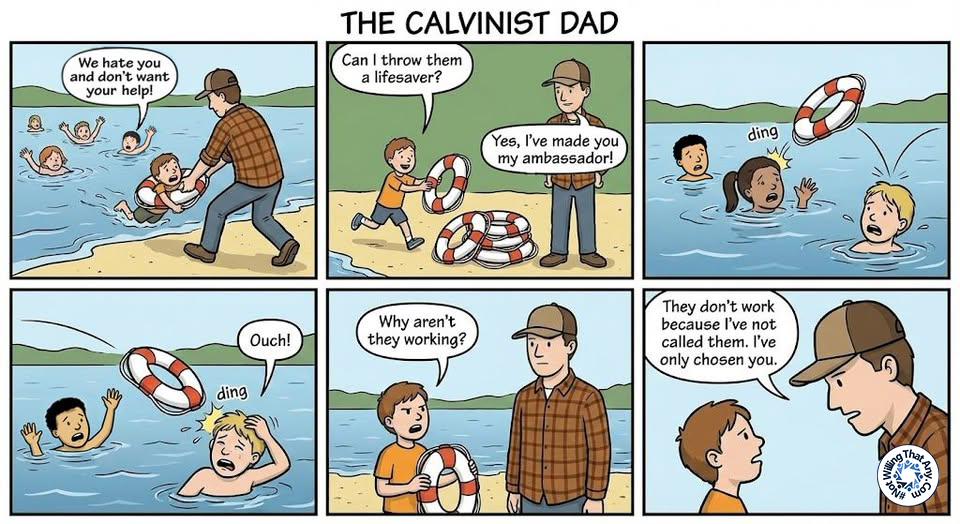
This illustration is the second in the series titled The Calvinist Dad. A reader suggested that the child who had already been rescued should be the one to throw the lifesavers to the others in the lake. That idea shaped the direction of the cartoon.
At first glance, you would expect the lifesavers to work. They look like real means of rescue. Yet in the illustration, the children in the water cannot be saved unless the Father also calls them. The goal is to show how, within Calvinism, the atonement of Christ is not effective on its own. It only becomes effective if God first decrees it.
The Breakdown:
Panel 1
This panel is meant to show two ideas. First, the children in the water represent total depravity. They cannot save themselves. Second, the rescued child contributes nothing to his own rescue. The lifesaver fully surrounds him. He is not holding on or pulling himself out. He is saved entirely by the Father’s action and choice.
Panel 2
After being rescued, the child sees others still in danger. The Father sends him as an ambassador, giving him lifesavers to throw. This reflects the idea that believers are sent as messengers of reconciliation, as described in Scripture.
Panels 3 and 4
The lifesavers fail to rescue the others. They bounce off and do not help. The children in the water are unable to hold onto them. This represents the belief that, because of total depravity, the means themselves cannot save unless something more happens first.
Panel 5
The rescued child is confused. Acting as an ambassador, he expected the lifesavers to work. His question reflects a natural assumption that the rescue tool itself should be effective.
Panel 6
The Father explains that the lifesavers do not work unless He has first called those in the water. This points to the Calvinist understanding that election comes before the application of atonement. Only those chosen are able to be saved, even when the means of rescue are present.
The illustration is meant to raise a question. If the lifesaver cannot save unless the Father first chooses the person, then where does the saving power truly lie. In the means offered, or only in the decree behind them.