
Quick Take:
If God has truly written His moral law on the human heart, how should we understand the real acts of kindness, courage, and care we see even among those who do not yet believe?
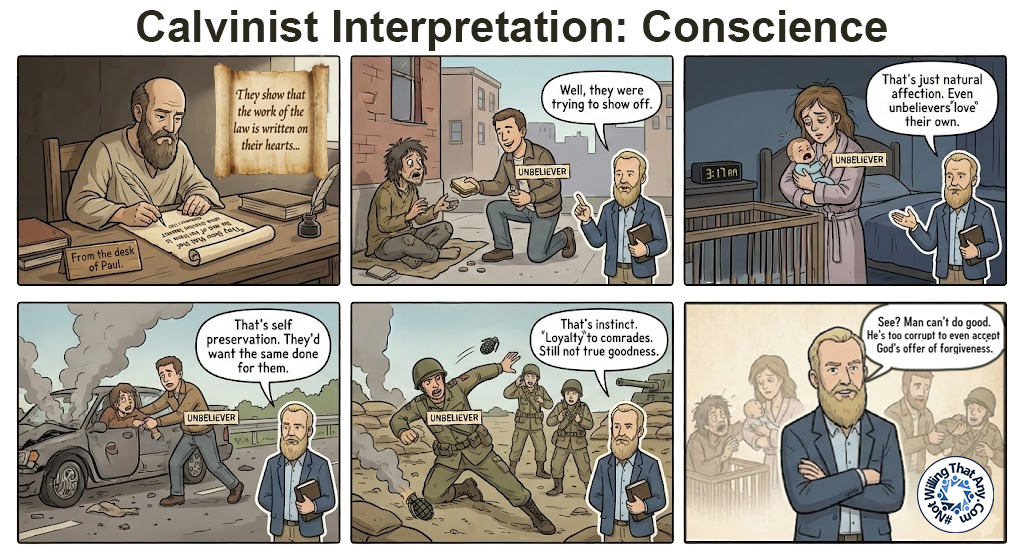
This illustration explores a tension within Calvinist theology over how conscience and observable moral actions are interpreted. Scripture teaches that the work of the law is written on human hearts and that conscience bears witness to this reality (Romans 2:14–15). Yet in the scenes shown, every act of generosity, affection, sacrifice, or bravery performed by unbelievers is repeatedly reclassified as mere instinct, self-interest, or social conditioning rather than a meaningful moral response. The illustration presses whether such explanations fully account for the biblical claim that conscience genuinely testifies to God’s moral order even in those who do not yet believe. By consistently dismissing these actions as incapable of reflecting true good, the framework risks emptying conscience of its evidentiary role and dulling the force of God’s universal witness to humanity (Acts 14:16–17; John 1:9), despite Scripture’s insistence that this witness leaves people without excuse and calls them toward repentance and truth (Romans 1:19–20; Romans 2:16).
Is it an accurate picture of Calvinism?
Below are five ways the illustration does accurately represent core Calvinist commitments, noting where each appears and offering a brief explanation.
Total Depravity: Where it appears: In each panel where moral actions by unbelievers are reinterpreted or dismissed.
Why it fits: Calvinism teaches that sin affects every aspect of human nature, so even outwardly good actions do not arise from a heart oriented toward God and therefore lack true spiritual goodness.
Common Grace Without Saving Power: Where it appears: Scenes showing kindness, sacrifice, affection, or courage that are acknowledged but explained away as instinct or self-interest.
Why it fits: Calvinism affirms common grace that restrains evil and enables social good, while maintaining that such actions do not move a person toward salvation or please God apart from faith.
Conscience as Condemning, Not Converting: Where it appears: The opening panel referencing the law written on the heart, followed by repeated reclassification of conscience-driven actions.
Why it fits: In Calvinism, conscience bears witness to God’s moral law and leaves people without excuse, but it does not function as a means by which unbelievers are drawn to God savingly.
God-Centered Definition of True Good: Where it appears: The final evaluative panel where all actions are judged insufficient.
Why it fits: Calvinism defines true goodness as that which flows from faith and aims at God’s glory, not merely outward conformity or compassionate behavior.
Inability Apart From Regenerating Grace: Where it appears: The cumulative effect of every appeal failing regardless of content.
Why it fits: Calvinism teaches that apart from sovereign regeneration, no amount of revelation or moral awareness can produce a positive response to God.
A question to consider:
If you are a Calvinist reading this and you recognize that the illustration accurately reflects key commitments of your theology, do you agree with the picture it presents? Does seeing these doctrines placed side by side, not as abstractions but as lived interpretations, match how you understand God’s character, human responsibility, and the role of conscience and revelation in Scripture? Why or why not?