
Quick Take:
What does it mean to hold people accountable for rejecting the light if that light is said to be powerless to overcome their blindness?
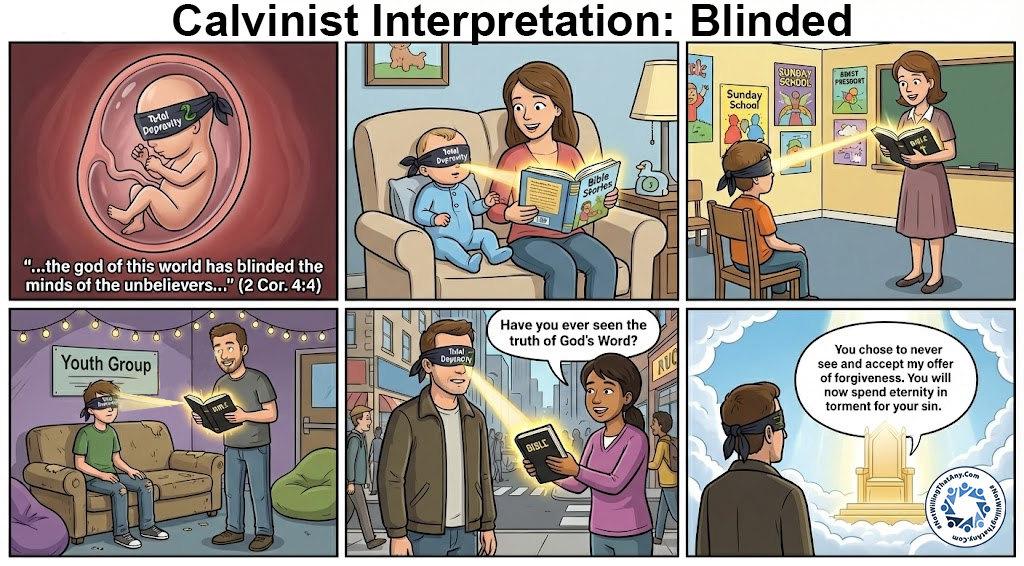
This illustration highlights the tension created when spiritual blindness is treated as an unchangeable condition that only God may remove, depicting a life repeatedly exposed to the light and power of God’s Word yet rendered ineffective by a blindness stronger than the message itself. The tension sharpens when judgment condemns the person for not seeing what he was never able to see, even though Scripture presents God’s Word as inherently powerful and genuinely revelatory to those who hear it (Romans 1:16; Romans 10:17), describes unbelief as a refusal to come to the light rather than an inability to do so (John 3:19–20; John 5:40), and consistently calls sinners to respond, repent, and believe with the assumption that the message itself is sufficient to make the truth known (Isaiah 55:1; Acts 17:30; Acts 26:26–27).
Does it accurately reflect Calvinism?
The aim of this illustration is accuracy, not exaggeration. It is meant to ask whether this depiction faithfully reflects what Calvinist theology itself teaches about spiritual blindness, revelation, and responsibility when those doctrines are held together. The question is not whether the image feels severe, but whether it matches the system.
Moral Inability: In Calvinism, spiritual blindness is not merely resistance to truth but an inability to perceive it savingly. From birth, the unregenerate person is unable to respond rightly to God’s revelation apart from grace (2 Corinthians 4:4; Romans 8:7–8). The illustration reflects this by showing blindness present prior to and throughout exposure to the light.
Total Depravity: The blindness persists through every stage of life and every form of exposure to God’s Word. Scripture may be heard, explained, and even understood at a surface level, yet it remains ineffective for salvation until God intervenes (1 Corinthians 2:14; Ephesians 2:1–3). The repeated exposure shown in the image mirrors this claim.
External Revelation: God’s Word is portrayed as genuinely present and sincerely proclaimed. The Bible is taught in homes, churches, and public settings, yet its saving effect is withheld by the condition of the hearer rather than any deficiency in the message itself (Romans 10:14–17). The illustration does not deny revelation; it shows its non-decisive role within Calvinism.
Regeneration Priority: Sight must be granted before belief can occur. In Calvinist theology, regeneration precedes faith, meaning blindness must first be removed before the light can be truly seen or received (John 1:12–13; John 6:44; Ephesians 2:4–5). The illustration reflects this order by showing no meaningful response until blindness would hypothetically be lifted.
Judicial Accountability: Despite moral inability, the unbeliever remains accountable for rejecting the light. Judgment follows not because the message was unclear, but because the person stands guilty before God even while unable to respond apart from grace (Romans 9:18–21). The final scene reflects this tension between inability and responsibility as Calvinism holds them together.
Taken together, the illustration does not claim that Calvinists deny the power of Scripture or the sincerity of God’s call. It portrays how, within Calvinism, spiritual blindness renders revelation non-decisive unless preceded by regenerating grace, while accountability remains fully intact.
That leaves the central question unchanged: if this is an accurate picture of Calvinist theology, is it one you can accept?