
Quick Take:
How should Isaiah’s grief filled words about rebellious children be understood if Romans 9 is taken as the controlling framework?
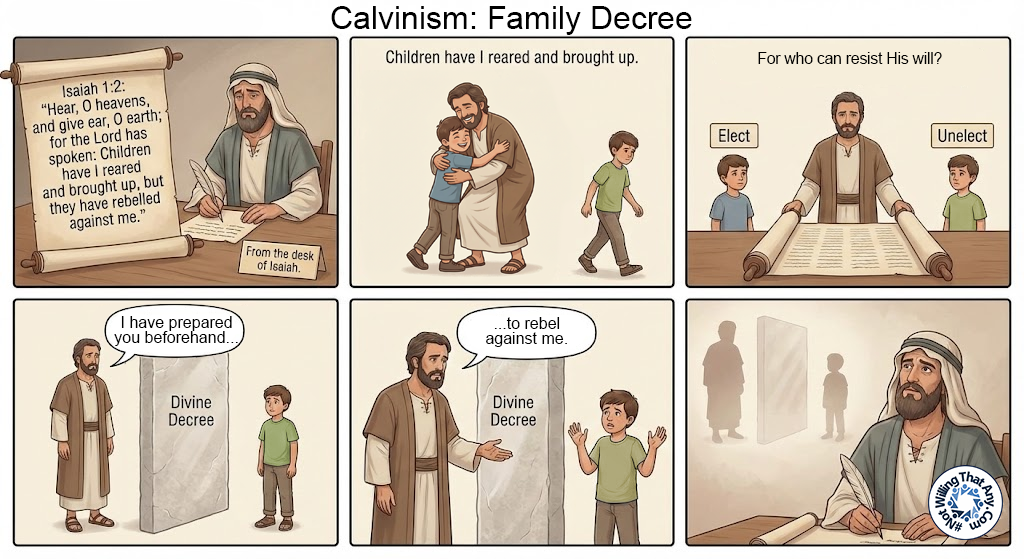
This illustration highlights the tension between God’s parental lament in Isaiah 1:2 and a Calvinist reading of election and decree. Isaiah presents God as a Father who genuinely reared His children, loved them, and was wounded by their rebellion. Yet when this scene is filtered through Romans 9, rebellion is no longer simply a tragic response to grace but something that unfolds within a prior divine decree. The image presses the question of whether God’s sorrow over rebellion can be fully sincere if the outcome was eternally settled, and whether rebellion is best understood as a freely chosen rejection of love or as the inevitable outworking of a decision made before the child was ever raised.
Is it an accurate picture of Calvinism?
The aim of this illustration is accuracy, not exaggeration. It attempts to visualize what Calvinist theology itself requires when Romans 9 is allowed to govern how Isaiah 1:2 is interpreted.
Parental Language:
Calvinism affirms that Scripture uses real parental language to describe God’s relationship with His people. Isaiah’s description of God rearing and bringing up children is understood as sincere and meaningful, even if God’s eternal decree ultimately determines the outcome (Isaiah 1:2).
Unconditional Election:
The separation between the two children reflects the Calvinist conviction that God’s saving choice is not based on the child’s response, effort, or will, but on God’s sovereign mercy alone (Romans 9:11–16).
Divine Decree:
The wall labeled “Divine Decree” accurately represents the Calvinist belief that God’s eternal plan precedes and governs all historical outcomes, including belief and rebellion. Nothing occurs outside of what God has ordained (Ephesians 1:11).
Moral Responsibility:
Calvinism maintains that even though outcomes are decreed, humans remain morally responsible for their actions. Rebellion is still real rebellion, even if it unfolds according to God’s sovereign plan (Romans 9:19–21).
Judicial Language:
The accusation “You have rebelled against me” reflects Calvinist teaching that God’s judgment is just, not because humans could have acted otherwise in an ultimate sense, but because they act according to their nature and desires (Romans 8:7–8).
Taken together, the illustration does not deny Calvinist claims about God’s sovereignty, human sinfulness, or election. It portrays them as Calvinism itself articulates them. What it places before the viewer is the unresolved tension between God’s expressed grief over rebellion and a framework in which that rebellion unfolds within an unalterable decree.
If this is an accurate picture of how Isaiah’s parental lament must be understood through Romans 9, is this tension one that can be lived with honestly, or does it point to a deeper conflict between God’s revealed heart and the system used to explain it?