
Quick Take:
If God chooses only a few to be saved, what does that mean for everyone else?
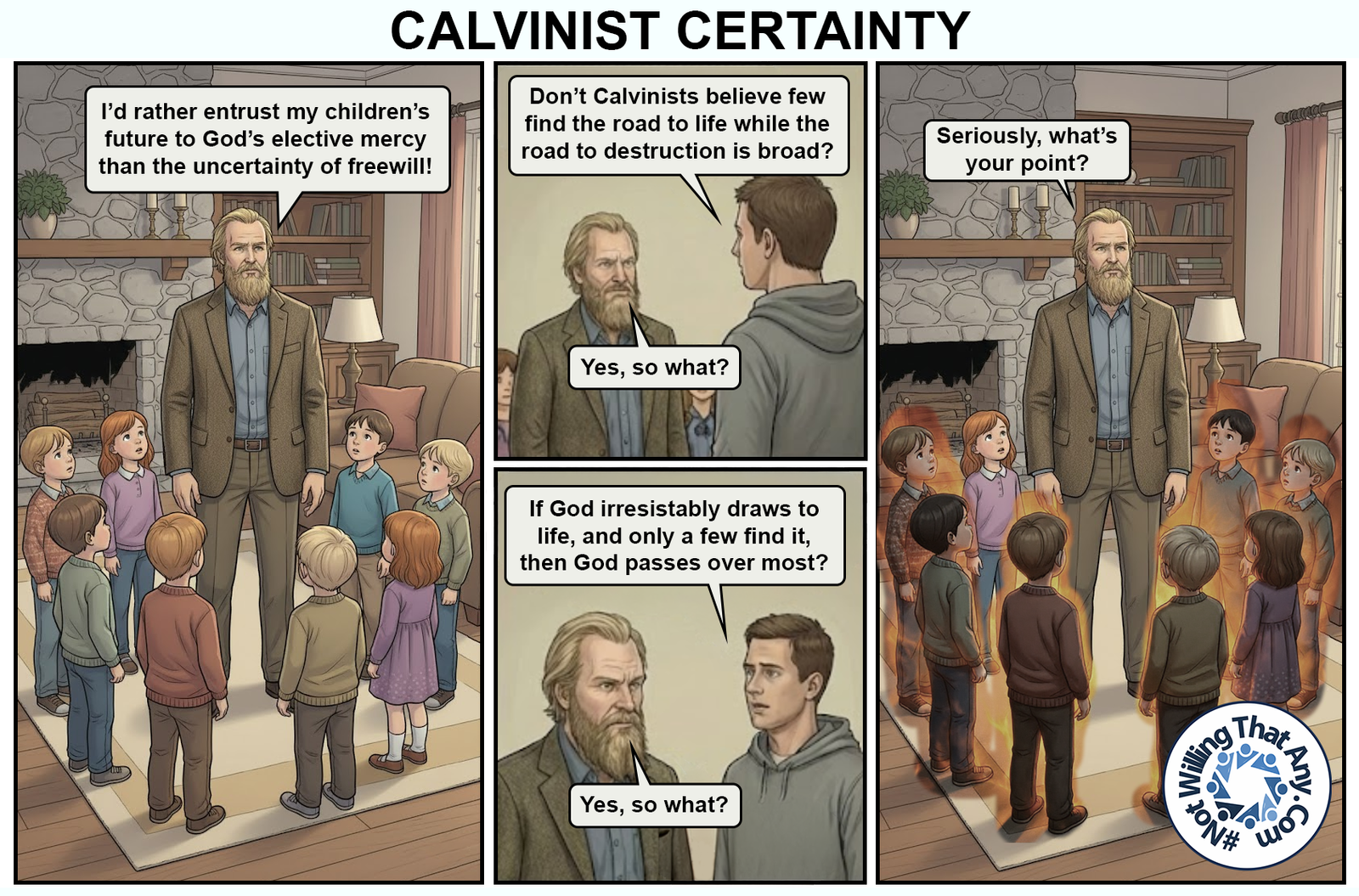
This illustration argues that Calvinist certainty comes with a serious question attached to it. The father says he would rather trust God’s selective mercy than human freewill. The other speaker presses the point that if only a few find life and God irresistibly draws them, then most people are passed over. The image contrasts the father’s calm confidence with the children standing around him, making the viewer wrestle with whether this kind of certainty fits with the heart of God.
Does this accurately reflect Calvinism?
Before offering any critique, it is important to say this illustration is trying to represent Calvinism fairly. Many Calvinists truly believe salvation rests entirely on God’s sovereign choice, not on human will. They believe this protects God’s glory and gives real assurance. The father’s confidence in the image reflects that sincere conviction. The goal here is not to mock, but to take Calvinism at its own claims and follow them to their logical conclusions.
First, the illustration reflects Total Depravity and the “fewness” of salvation. Calvinists often point to Romans 3:10 to 12, which says none seek for God, and Ephesians 2:1, which describes sinners as dead in trespasses. They also connect this to Matthew 7:13 to 14, where Jesus says few find the narrow road. The comic takes this seriously. If no one can come unless God intervenes, and only a few find life, then salvation depends completely on God’s action, not human response.
Second, the dialogue highlights Unconditional Election and Irresistible Grace. Calvinists commonly use John 6:37 and John 6:44 to teach that all the Father gives to the Son will come, and that no one can come unless drawn. Romans 9:15 to 16 is also central, showing mercy depends not on human will but on God. The father’s statement about trusting God’s selective mercy reflects this belief. The repeated “Yes, so what?” captures the idea that God has the right to choose according to His own purpose.
Third, the question about God “passing over most” reflects Limited Atonement and the reality of reprobation. Many Calvinists teach that Christ died specifically for the elect, based on passages like John 10:11, where Jesus lays down His life for the sheep, and Ephesians 1:4 to 5, which speaks of being chosen before the foundation of the world. If the atonement is particular and grace is effectual only for the elect, then those not chosen are left in their sin. The illustration simply visualizes that outcome.
The tension comes when we compare this understanding with the broader witness of Scripture about God’s character. The Bible also says God desires all people to be saved and to come to the knowledge of the truth in 1 Timothy 2:4, that He is not willing that any should perish in 2 Peter 3:9, and that He takes no pleasure in the death of the wicked in Ezekiel 18:23. When placed beside the Calvinist system, this raises a hard question: does the picture of selective, irresistible mercy fully reflect the heart of a God who openly calls all to repentance, or does it require rethinking how we understand His sovereignty and love?