Select Page

Calvinism – The Narrow Road Information Booth

Jan 26, 2026

Quick Take:

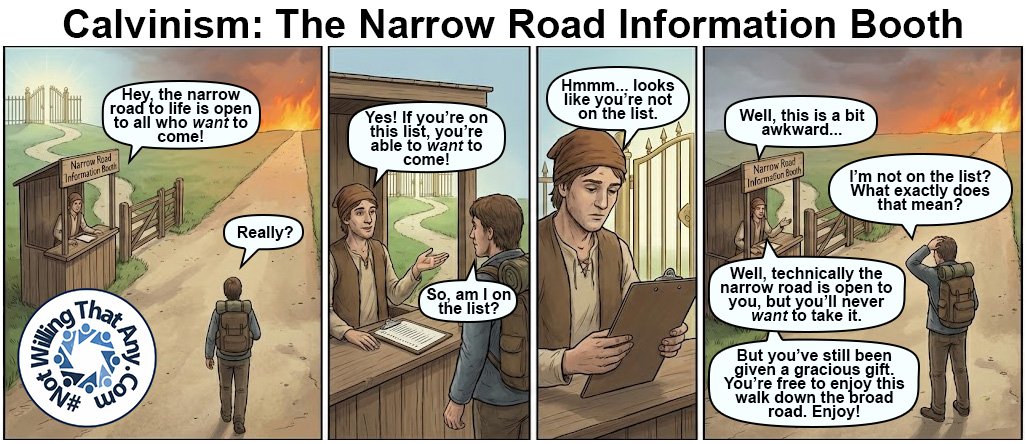
Is a road truly open to you if you are never able to want to take it?

This illustration presses on that tension. It reflects how Calvinism can sincerely proclaim the gospel as open to all, while also teaching that only those on God’s eternal list will ever desire or be able to respond. The road is not physically blocked, but for some, it is effectively unreachable by design.

Is it an accurate picture of Calvinism?

This illustration is trying to represent Calvinism fairly, not caricature it. A Calvinist would rightly say the problem is not that God locks the door, but that the sinner freely rejects mercy because of his sinful nature. The scene is framed from the experience of the unelect person, who is totally depraved, unable to want what God requires, and who would have come if God had chosen to grant that desire. The tension shown is intentional and reflects how the doctrine works from the human side of the equation.

Total Depravity and Moral Inability

The man is told the narrow road is open, yet he is later informed that he will never want to take it. This reflects the Calvinist view that all people are morally unable to come to God on their own. Passages like John 6:44 and Romans 8:7–8 are often cited to show that fallen humans cannot desire God unless first acted upon by grace. The illustration reflects this accurately by showing that the man’s inability is internal, not external, yet still decisive.

Unconditional Election and the “List”

The clipboard list represents unconditional election. The determining factor is not the man’s response, interest, or effort, but whether his name is on the list. This aligns with passages such as Romans 9:15–16 and Ephesians 1:4–5, where God’s choice is not grounded in foreseen faith but in His sovereign will. The booth worker does not deny access to the road; he simply reveals that the man was not chosen to desire it.

Sincere Offer and Common Grace

The final panel emphasizes that the man is still given gifts and allowed to enjoy the broad road. This reflects the Calvinist distinction between saving grace and common grace. God genuinely commands all to repent (Acts 17:30) and shows kindness to all (Matthew 5:45), even though only the elect receive regenerating grace. The offer is real, but the outcome is fixed. The illustration captures this tension without overstating it.

If this is an accurate picture of how Calvinism functions in lived experience, especially from the perspective of the unelect, does it align with the biblical portrait of God’s desire, justice, and love? And does it leave you at peace with how mercy is offered and withheld, or does it raise questions that deserve further examination?

A Calvinist Redo:

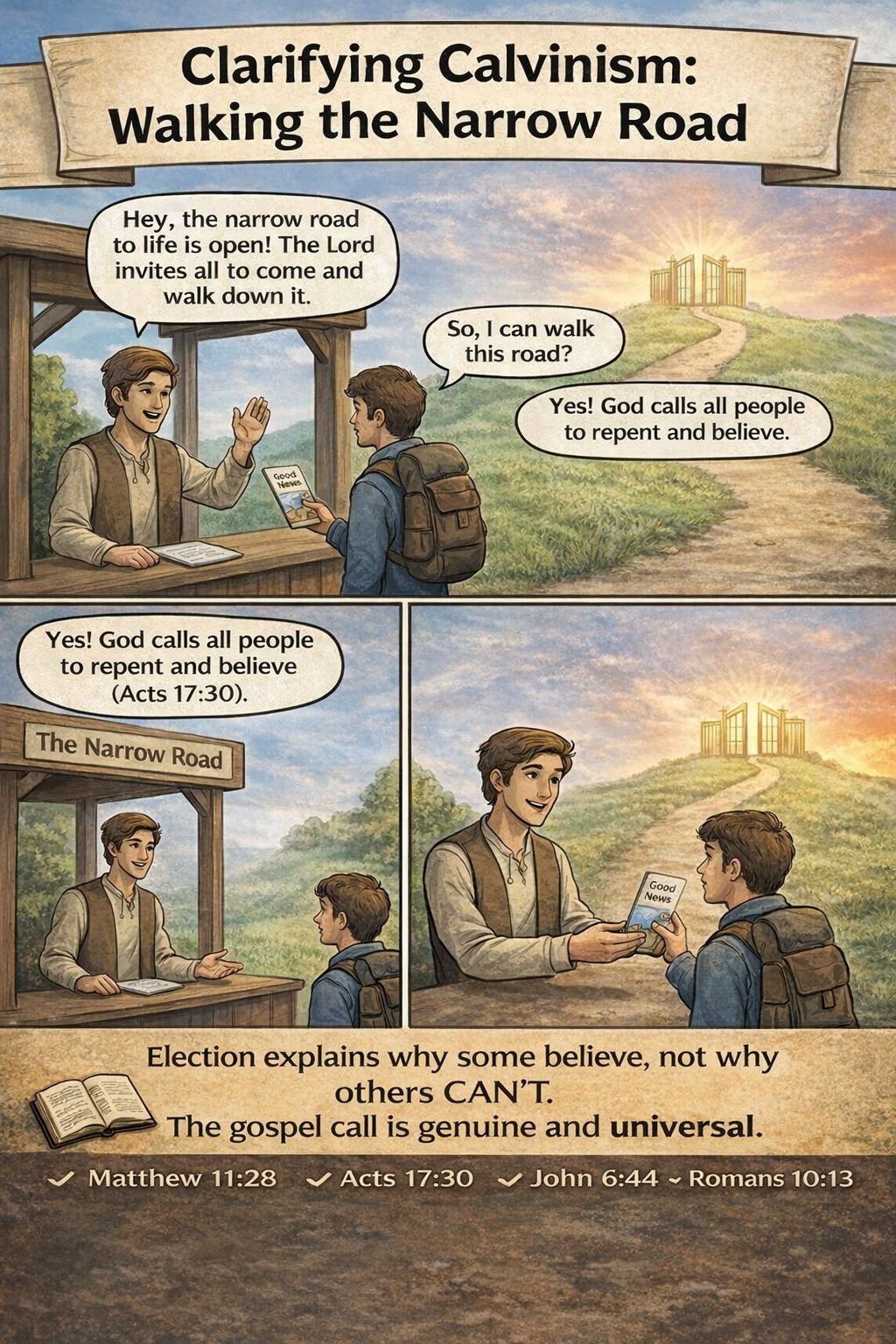
There was a user, Edison Calma Sanchez, who produced this illustration in response (posted publicly). The redo was meant to present Calvinism in its best light by emphasizing the sincerity of the gospel call and removing language that might sound exclusionary. To a Calvinist reader, the illustration feels faithful, warm, and consistent with how the gospel is normally preached without reference to election.

The concern raised by non-Calvinists is not about tone or intent, but about what the system itself entails when all the theological pieces are kept in view. In the original context, the information attendant possesses the list of the elect. That detail matters. If the traveler is not on that list, then the following realities are already settled within Calvinist theology:

The traveler has NO access to the road.
The traveler CANNOT WANT to walk the narrow path.
The traveler was DESTINED for destruction.
The traveler will ONLY walk the broad path.
The traveler has ZERO hope of life.
The traveler has been EXCLUDED from God’s salvific love.

But the attendent says, “Yes!”

From a non-Calvinist perspective, this is where the deception enters, even if unintentionally. The word “can” is doing heavy work. In ordinary language, it communicates real ability and genuine access. But within Calvinism, that ability exists only for the elect. The invitation is sincere as a command, yet impossible as a response for the unelect. What is spoken sounds universally accessible, while what is actually possible is strictly limited.

The invitation, then, is not false in wording but misleading in effect. It reassures the traveler while quietly presupposing an outcome already fixed by divine decree. Calvinists are invited to consider whether this way of speaking truly clarifies their theology, or whether it unintentionally masks a tension between the language of open invitation and the reality of unconditional election.

Interesting Feedback:

I find fault with this because somehow the person inviting the traveler to take the narrow road has the list. According to the biblical doctrine of sovereign grace, our job in evangelizing is to tell everyone about both roads and where they lead. We don’t know who God will show mercy on and who he will not show mercy on. We don’t know who the spirit will convict of sin and reveal salvation to. We also have no reason to explain sovereign grace to non-believers. That is like casting pearls before swine. Free will and Sovereign grace both demand that we take the gospel to all of the world. Not that we can convert the sinner, but that God can. Once a person has received the spirit and salvation, then we have a responsibility as a church to educate them on the full doctrines that Christ and the apostles taught. Starting with the milk of the word and growing to the meat. The doctrine of sovereign grace or free will is the meat of the word. Not something you spring on a non-believer or newly converted believer. Therefore I find this to be an inaccurate depiction. – Posted Publicly: Leland Rex Roc Smith
RESPONSE: Theology Should Stand in the Open

Christian theology is not meant to be hidden, delayed, or protected from inspection. Scripture consistently presents God’s truth as something spoken plainly and publicly. Paul says that believers should renounce secrecy and distortion and instead commend the truth openly to everyone’s conscience (2 Cor. 4:2). This assumes that doctrine can be examined, questioned, and understood in the open, not reserved for a later stage or a smaller group. If a belief cannot be clearly described in front of unbelievers, that problem lies with clarity, not with spiritual maturity.

The Bible’s language about “milk” and “meat” is often misunderstood. In Hebrews, the issue is not that some doctrines are too dangerous or advanced to share, but that some believers have failed to grow in obedience and discernment (Heb. 5:12–14). The “meat” of the Word is deeper alignment with what God has already revealed, not secret knowledge introduced later. Scripture itself is public revelation. It is preached openly, read openly, and tested openly.

This openness is reinforced by the example of the Bereans, who were praised for examining the Scriptures daily to see whether what they were hearing was true (Acts 17:11). Their careful testing was not treated as rebellion or immaturity, but as faithfulness. Christian teaching, by design, invites scrutiny. Growth happens not by withholding theological clarity, but by returning again and again to God’s Word, allowing it to shape belief and life more fully.

In this sense, theology does not belong to a guarded inner circle. It belongs in the light. The gospel is proclaimed to all, and the doctrines that flow from Scripture must be able to endure honest examination by anyone who hears them.