Select Page

Calvinism – The List

Jan 22, 2026

Quick Take:

What happens when a theological system is pictured from the inside of a parent’s love rather than from the safety of abstraction?

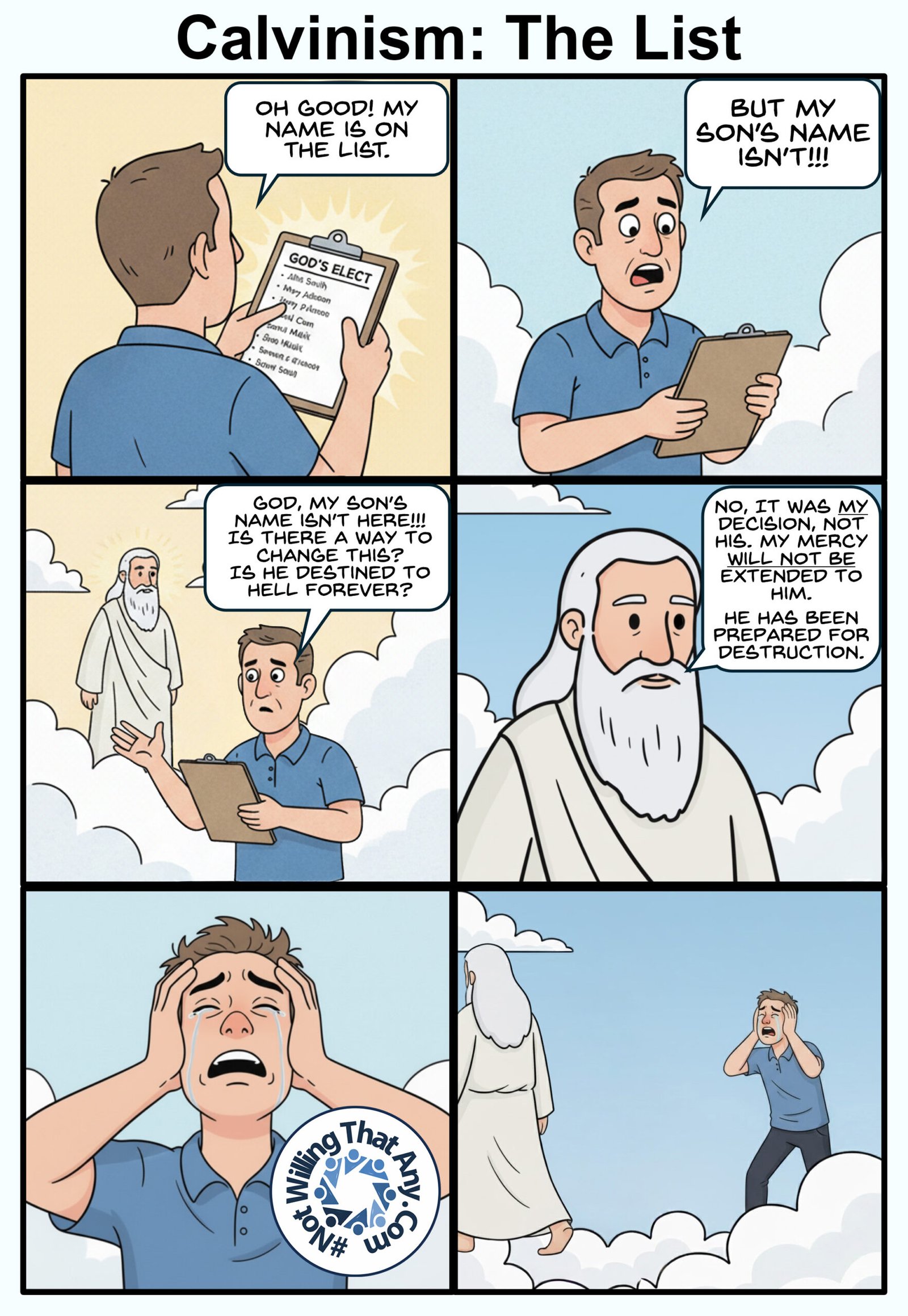
This illustration presses Calvinism into a deeply personal frame, asking whether a doctrine that feels orderly on paper still makes moral and emotional sense when applied to a father pleading for his own child. The discomfort is intentional. It invites reflection on whether the system, as lived and felt, aligns with the God revealed in Scripture.

Is it an accurate picture of Calvinism?

This illustration aims to present Calvinism as its advocates understand it, not as a caricature. The man’s son is not excluded because of lack of effort, ignorance, or opportunity, but because of an eternal divine decision made apart from him. The pain in the image is not meant to deny Calvinist sincerity or pastoral care, but to portray what the doctrine necessarily looks like when applied consistently to real relationships.

Unconditional Election:
In Calvinism, election is not based on foreseen faith or response but on God’s sovereign choice alone. The list represents that eternal decree. The father’s joy and devastation arise from the same source: a fixed decision made prior to any action by those named or unnamed. Romans 9:11–13 and Ephesians 1:4–5 are often cited to support this unconditional choosing.

Reprobation and Passing Over:
The response given to the father reflects the Calvinist claim that God’s mercy is selective and intentional. The son is not merely left without grace but is “prepared for destruction,” language drawn from Romans 9:22. While Calvinists distinguish between active election and passive reprobation, the lived result is the same: no possibility of mercy, no openness to appeal, and no change in outcome.

Total Inability and Moral Finality:
From the son’s perspective, there was never a door to open. On Calvinism, if God had chosen otherwise, the son would have come. Since He did not, coming was never truly possible. Passages like John 6:44 and Romans 8:7–8 are commonly used to affirm this inability. The illustration shows the emotional weight of that claim without arguing against it directly.

Taken together, the image asks a simple but pressing question: if this accurately reflects the system when fully applied, does it cohere with the character of God as loving, just, and genuinely merciful? It does not deny divine sovereignty or human sinfulness. It asks whether a theology that must be defended by abstraction remains defensible when translated into the language of love, grief, and irreversible loss.

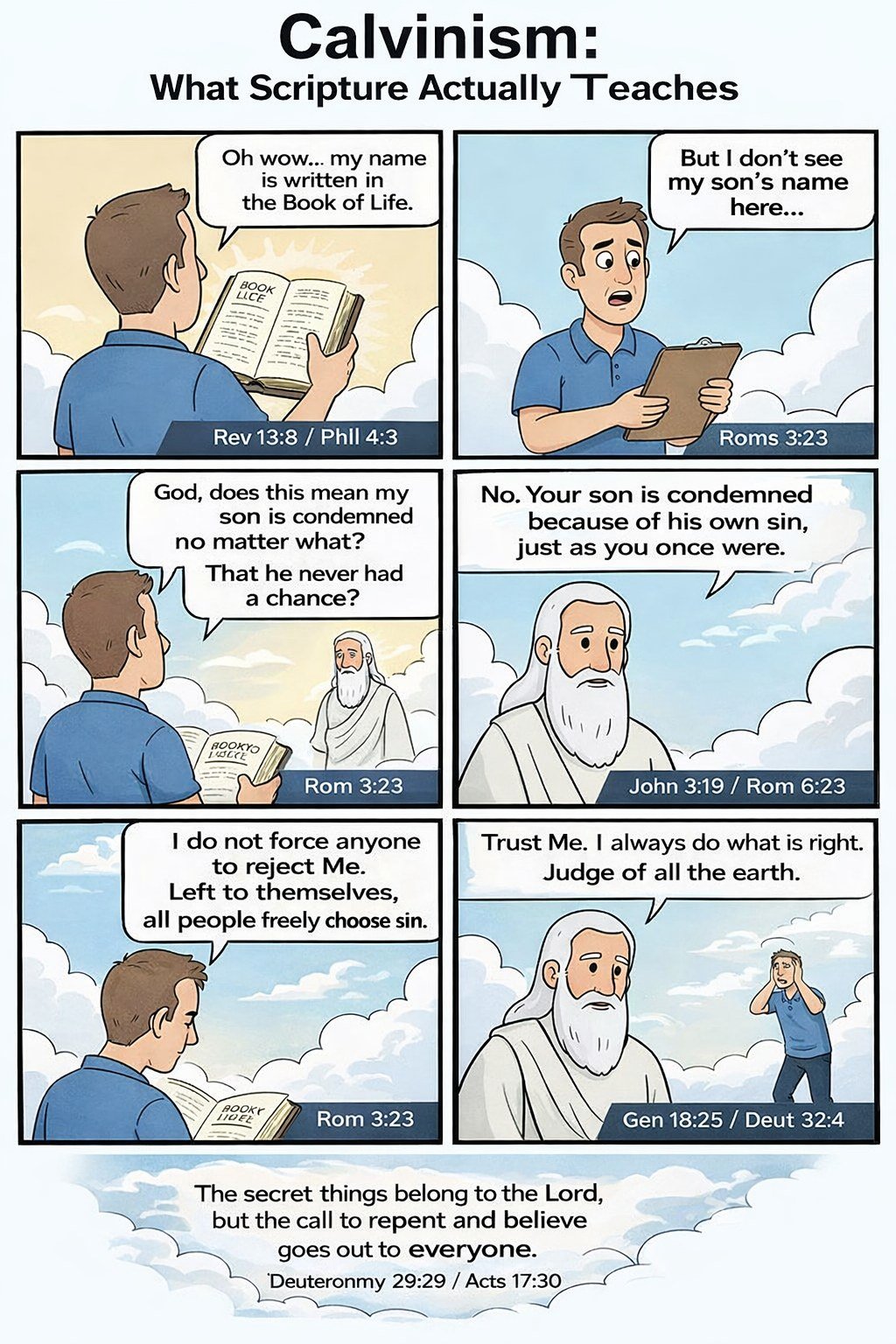
The Calvinist “Redo”

This illustration was produced as a Calvinist response to an earlier image created by NotWillingThatAny. It is being shared here to help a Calvinist reader notice the sleight of hand that occurs in the response. The stated aim is correction, but the effect is obscuring the system’s hardest claims. Especially the claim that God’s choice includes a prior decision of condemnation.

The man’s first two questions are simple and direct. Is my son condemned no matter what? Did he ever truly have a chance? In the first presentation, the answers are clearly No. Condemnation is tied to personal sin in history. The call to repent and believe is genuinely open.

On Calvinism, those answers cannot remain No. They must be Yes.

If election and reprobation are fixed before the foundation of the world, then the son’s outcome is settled before any response, desire, or decision. He is condemned no matter what occurs in time.

This is the point where the tension appears. Appeals to free choice or to God always doing what is right do not change the prior decree. They come after the decision has already been made. The father’s anguish is not confusion. It is the logical result of the system.

The redo does not expose a strawman. It exposes the strain. Pastoral language wants to say No. Doctrinal consistency requires Yes. The question is whether those hard truths can be spoken plainly, or only softened when they become too difficult to face.