
Quick Take:
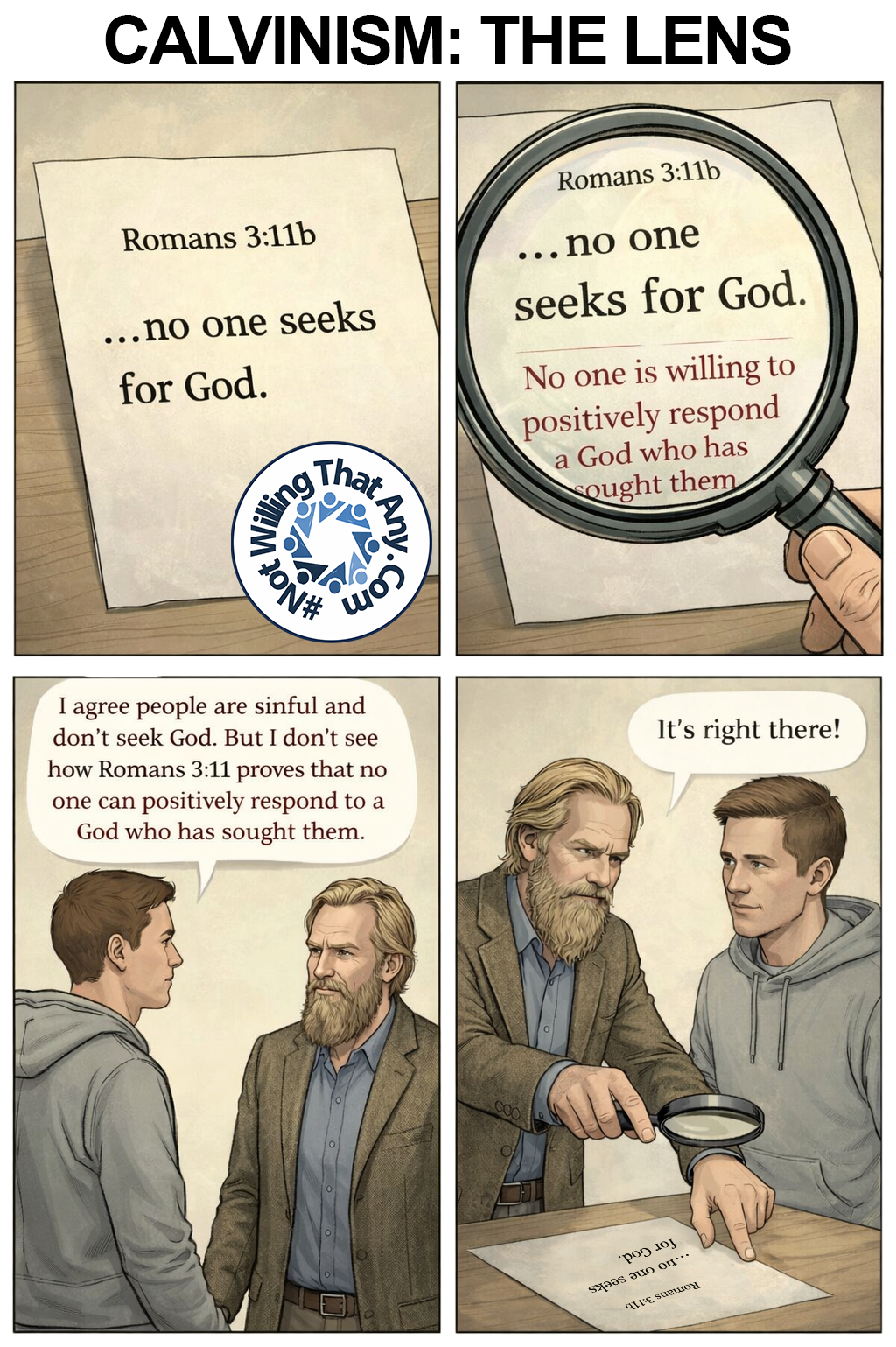
When you read something, do you see it through a lens?
Everyone brings assumptions and theological frameworks when they read Scripture. Romans 3:11 says, “…no one seeks for God.” The illustration asks whether a theological lens can sometimes add conclusions to a verse that the verse itself does not directly state. It invites readers to pause and consider whether they are seeing only the text itself, or the text together with an interpretive system that shapes how it is understood.
Is it an accurate picture of Calvinism?
This illustration is intended as a good faith reflection on how theological frameworks influence interpretation. Calvinists sincerely believe their conclusions about human inability come from Scripture itself. The goal here is not to mock that conviction, but to highlight how a system of theology can function like a lens that shapes what we think a verse must mean.
Total Depravity:
Romans 3:10–12 is frequently cited by Calvinists as evidence for Total Depravity. The passage says, “None is righteous, no, not one; no one understands; no one seeks for God.” Calvinists argue that this describes humanity as spiritually incapable of seeking God on its own. Because no one seeks God, they conclude that salvation must begin entirely with God’s initiative.
Moral Inability:
From this starting point Calvinists often argue that human unwillingness reflects a deeper inability. Passages such as Romans 8:7 (“the mind that is set on the flesh is hostile to God”) and 1 Corinthians 2:14 (“the natural person does not accept the things of the Spirit of God”) are used to support the idea that fallen people cannot positively respond to God unless their nature is first changed.
Irresistible Grace:
If fallen people cannot respond on their own, Calvinists reason that God must intervene in a decisive way to bring someone to faith. This leads to the doctrine commonly called Irresistible Grace. Texts like John 6:37 and John 6:44 are often cited to argue that when God draws someone savingly, that drawing effectively results in faith.
The question raised by the illustration is not whether people are sinful or whether God initiates salvation. Most Christians agree on both points. The question is whether Romans 3:11 itself teaches that no one can positively respond when God seeks them, or whether that conclusion is coming from a broader theological framework applied to the text. If you were asked to defend the non-Calvinist reading of this passage, could you clearly explain why someone might see the verse differently and understand their perspective, even if you ultimately disagree with it?