
Quick Take:
When we see something, are we sure we are really seeing it clearly?
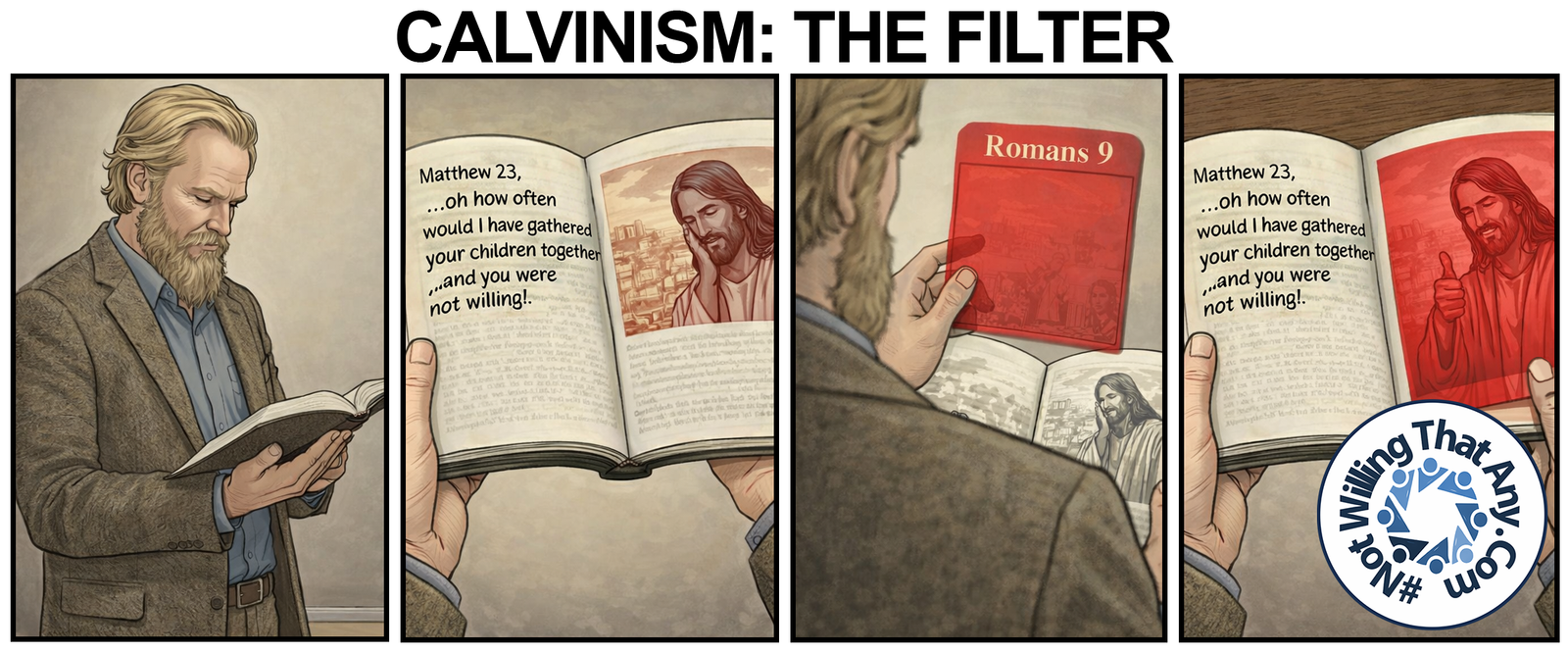
Sometimes we look at something and feel certain we understand it, but our viewpoint can shape what we think we see. A filter can highlight one part of a picture while muting another part. That is true in everyday life, and it can also happen when we read Scripture. This illustration raises the question of whether a person can become so focused on one passage or system that he starts to read the rest of the Bible through it, even when the plain picture in front of him says something else.
Is it an accurate picture of Calvinism?
This illustration is meant to be respectful, not mocking. It is not saying Calvinists are foolish or careless. It is trying to raise a serious concern in a visual way. The question is whether a strong system can sometimes shape a passage so much that the plain sense feels changed.
Unconditional Election: The red filter says “Romans 9,” and that points to one of the main Calvinist passages for election. Calvinists often look to Romans 9:11-18 and Ephesians 1:4-5 to show that God chooses people according to His own purpose. In that view, Matthew 23 must be read in a way that does not conflict with God’s sovereign choice.
Total Depravity and Irresistible Grace: Calvinists also connect this to man’s inability in sin. They often use John 6:44 and Romans 8:7-8 to argue that fallen people cannot come to Christ unless God first draws them. So when Jesus says, “you were not willing,” many Calvinists understand that unwillingness as flowing from a deeper inability.
Definite Atonement: The changed image of Jesus presses on another part of TULIP. Calvinists often point to John 10:11, Matthew 1:21, and John 17:9 to argue that Christ came in a special saving way for His people. This illustration asks whether that framework can end up softening the full emotional force of Jesus weeping over those who refused Him.
If this is a fair picture of Calvinism, then it may deserve closer thought. Does Romans 9 really require us to place this kind of filter over Matthew 23? Or could Romans 9 be understood in another way that lets Christ’s sorrow and desire stand in their full strength? If so, would that be worth exploring more carefully?