
Quick Take:
When you share the gospel, are you saying the same thing your theology actually believes?
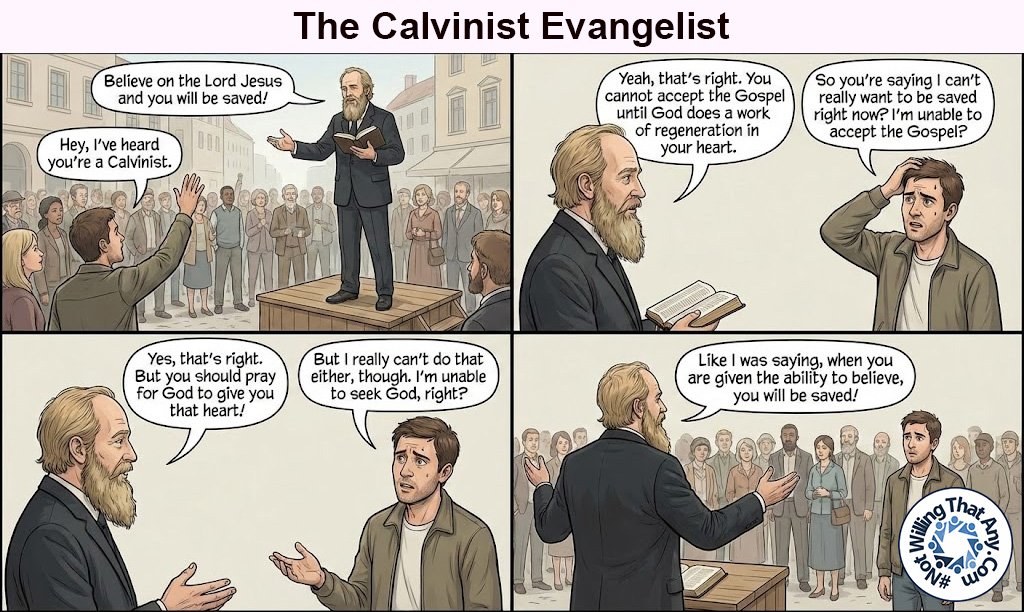
This image shows a common tension in Calvinist evangelism. In public, the message sounds simple and open: believe in Jesus and you will be saved. But when the theology is explained, the unbeliever learns that they cannot believe, cannot want to believe, and cannot even seek God unless God first changes them. The invitation sounds real at first, but once the system is understood, it becomes hard to see how salvation is truly something the listener can respond to at all.
Is it an accurate picture of Calvinism?
To understand this image fairly, we have to describe Calvinism the way Calvinists themselves do. Calvinism teaches that all people are commanded to believe the gospel, but no one has the ability to do so unless God first gives them a new heart. People are responsible to believe, even though they are unable to believe on their own (John 6:44, Romans 8:7–8, Ephesians 2:1).
The Public Gospel Call
Panel 1 shows a Calvinist evangelist preaching the gospel the way most Calvinists do. The message, “Believe on the Lord Jesus and you will be saved,” comes straight from Scripture (Acts 16:31). It is spoken to everyone and sounds like a real choice. This is accurate. Calvinists believe the gospel should be preached freely to all people, even though only some will be able to respond.
Human Inability to Believe
Panel 2 explains what Calvinism believes is happening underneath that message. According to Calvinism, a person cannot accept the gospel unless God first regenerates them (John 3:3, John 6:65, 1 Corinthians 2:14). The evangelist’s explanation is not exaggerated. It is a direct statement of Calvinist doctrine. The unbeliever’s confusion makes sense because the call sounded like something he could do, but the explanation says he cannot.
Inability to Seek God
Panel 3 simply follows the logic of Calvinism. If a person cannot believe or desire salvation, then they also cannot seek God or even pray rightly unless God acts first (Romans 3:10–11). The unbeliever is not arguing against Calvinism here. He is repeating it back in his own words. The image lets the theology speak for itself.
Returning to Evangelistic Language
In Panel 4, the evangelist turns back to the crowd and resumes preaching in general terms. He again speaks about believing and being saved, without mentioning inability or regeneration. This reflects how Calvinist evangelism often works in practice. Calvinists believe God uses the preached word to give faith to the elect (Romans 10:17), even though the hearer has no control over whether they will be given that ability.
Taken together, the image shows Calvinism accurately. The gospel is preached to everyone, but the ability to respond is given only to some (Romans 9:16–18). The tension the unbeliever feels is not because he misunderstands, but because he understands clearly.
And that leads to a simple question worth thinking about. If the gospel sounds like it is up to you until the theology is explained, and once explained it no longer is, what is the unbeliever really being asked to do? And is it possible that the picture in Panel 4, where God truly desires all to be saved and genuinely enables all to respond, better matches both the message of the gospel and the character of God?