
Quick Take:
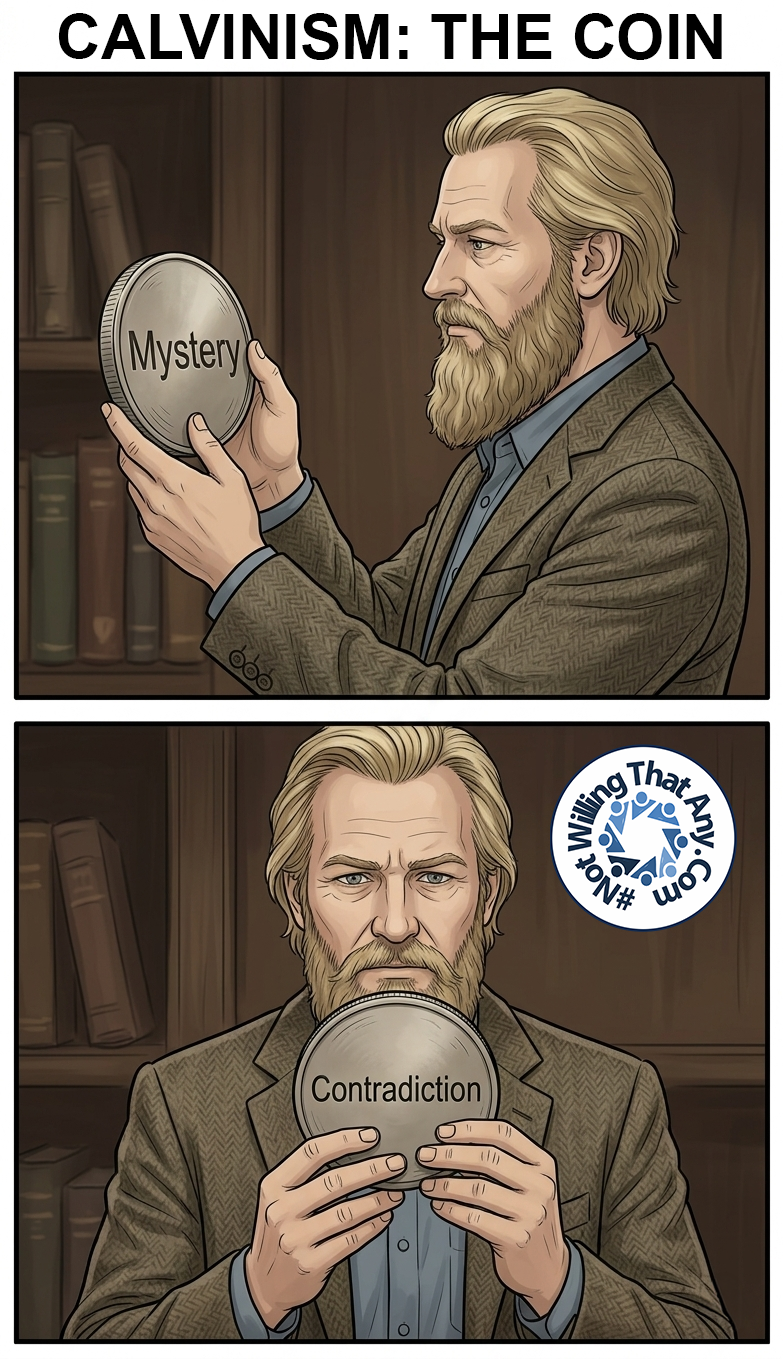
What’s the difference between a mystery and a contradiction?
In the Bible, a mystery is something real and true that we may not fully understand, but it still fits with everything else God has revealed. A contradiction, on the other hand, is when two ideas cancel each other out and cannot both be true in the same way. Christians rightly accept mystery, because God is greater than our understanding. But the question this raises is whether we are calling something a “mystery” when it may actually be two conflicting ideas placed side by side.
Is it an accurate picture of Calvinism?
This illustration is not meant to insult or mock Calvinists. It is meant to slow the conversation down and ask an honest question. When we appeal to “mystery,” are we preserving truth, or are we avoiding tension that needs to be examined more carefully?
Calvinism often speaks of mystery when holding together ideas like God’s complete sovereignty and human responsibility. Passages like Romans 9:15–16, “I will have mercy on whom I have mercy…” are used to emphasize God’s freedom, while other passages clearly call people to respond, repent, and believe. The tension is often explained as a mystery beyond human understanding.
Another common appeal to mystery comes in the idea that God desires all to be saved, yet only some are chosen. Verses like 1 Timothy 2:4, “who desires all people to be saved” are held alongside teachings of unconditional election. Rather than resolving how both function together, the explanation is often that this is part of God’s hidden will.
A third area is the concept of total inability alongside commands to believe. Scripture repeatedly calls people to respond, such as Acts 17:30, “he commands all people everywhere to repent.” Yet the system also teaches that Image-Bearers cannot respond unless first regenerated. This tension is again often placed under the category of mystery.
Contradiction?
If we slow down and lay the ideas side by side, some tensions begin to look less like mystery and more like contradiction. For example, if God genuinely desires all people to be saved (1 Timothy 2:4, “who desires all people to be saved and to come to the knowledge of the truth”) but has only chosen some and not others, in what sense is that desire universal? If the desire is real, it seems it would extend equally to all. But if the outcome is fixed for only some, then the “desire” begins to sound different than how we normally understand it. This is not mystery. This is contradiction.
If God commands all people to repent (Acts 17:30, “he commands all people everywhere to repent”) but some are unable to respond unless first regenerated, in what sense is that command meaningful for everyone? A command assumes the possibility of response. Otherwise, it begins to feel less like a genuine call and more like a declaration over those who cannot act. If the ability is not present, the responsibility becomes difficult to explain in a straightforward way. This is not mystery. This is contradiction.
And if people are held accountable for rejecting the gospel, yet were never given the ability to accept it, how does that align with God’s justice? Scripture presents God as perfectly just and upright (Deuteronomy 32:4, “all his ways are justice”). But holding someone responsible for what they could never do raises serious questions about how justice is being defined. If the inability is total and unavoidable, then the basis of judgment seems disconnected from personal response. This is not mystery. This is contradiction.
These are not small questions. They press us to ask whether the categories we are using are fully consistent, or whether we may be holding together ideas that do not actually fit the same way Scripture presents them.