
Quick Take:
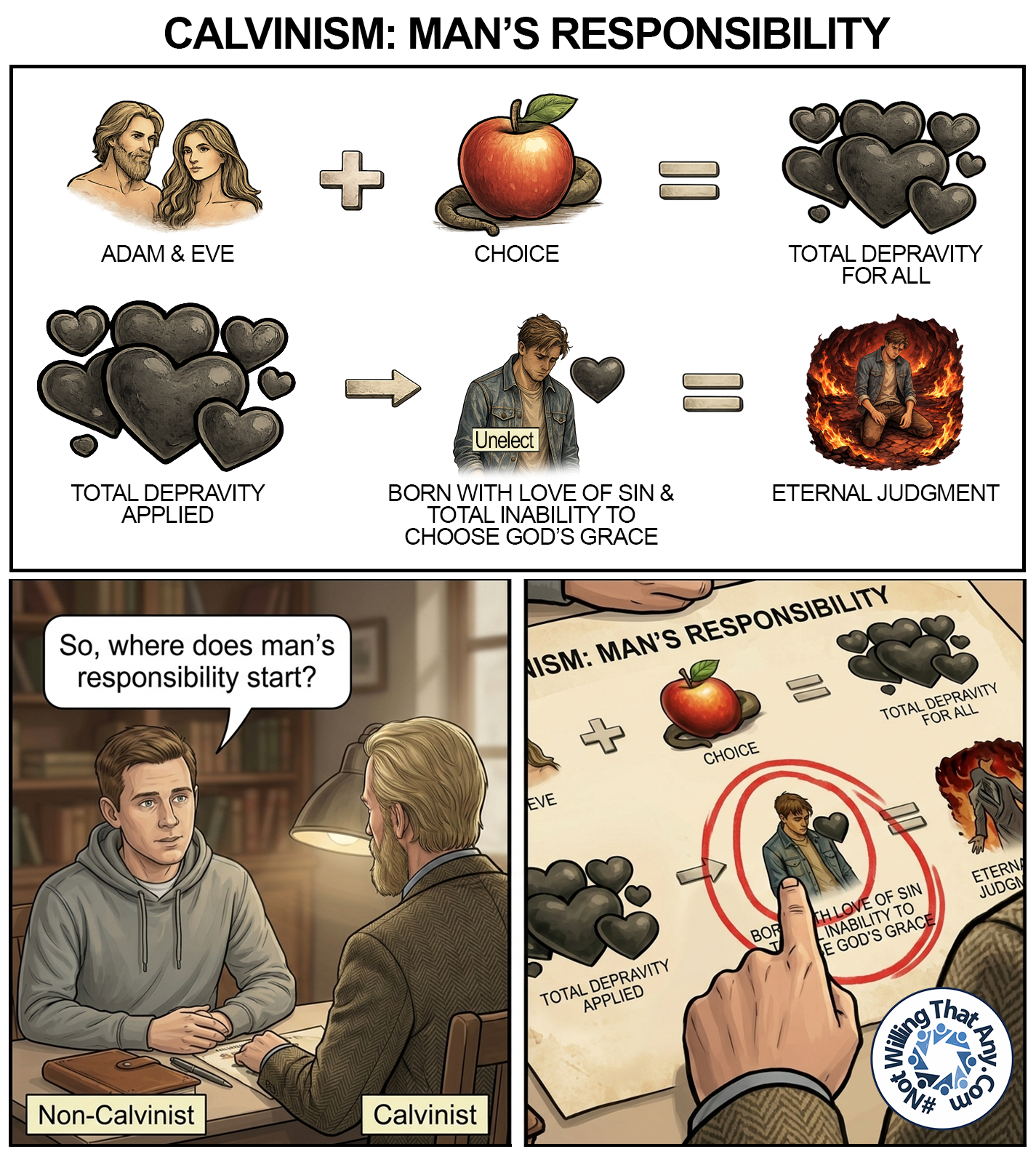
This illustration raises a simple question: At what point is a person actually responsible?
In the Calvinist system, a person is born with a nature that cannot choose God’s grace. If that is the case, then responsibility seems to be placed on someone at the very moment they are unable to respond differently. The concern the illustration raises is not mainly about whether people sin, but whether it makes sense to hold someone morally accountable for a choice they are said to be unable to make.
Is it an accurate picture of Calvinism?
The goal of this illustration is not to mock Calvinists or dismiss their theology. Many thoughtful Christians hold the Reformed view because they believe it best explains Scripture and preserves God’s sovereignty. The purpose here is simply to represent the system as fairly as possible and then ask whether the picture that results is both biblically coherent and logically understandable. Illustrations are never perfect, but they can help clarify how certain ideas connect when placed side by side.
Total Depravity:
The illustration begins with a man whose condition determines what he will do. This reflects the Calvinist doctrine of Total Depravity, which teaches that human beings are born with a sinful nature that prevents them from responding positively to God without divine intervention. Calvinists commonly appeal to passages like Romans 3:10–12, “None is righteous, no, not one; no one understands; no one seeks for God.” They also point to Ephesians 2:1, which says people are “dead in the trespasses and sins.” In Calvinist theology, this spiritual inability explains why people cannot choose God unless God first changes their heart.
Unconditional Election:
Another part of the illustration focuses on the fact that the solution to the man’s condition does not come from him but from God’s prior decision. This corresponds to the Calvinist doctrine of Unconditional Election, the belief that God chooses whom He will save before they respond. Calvinists often point to Romans 9:15–16, “I will have mercy on whom I have mercy… So then it depends not on human will or exertion, but on God.” They also reference Ephesians 1:4–5, which says God chose believers “before the foundation of the world.” In this view, salvation ultimately depends on God’s sovereign choice rather than human response.
Irresistible Grace:
The final part of the illustration reflects the Calvinist teaching that when God decides to save someone, His grace effectively brings that person to faith. This is often called Irresistible Grace. Calvinists commonly cite John 6:44, “No one can come to me unless the Father who sent me draws him,” and John 6:37, “All that the Father gives me will come to me.” In this understanding, those whom God chooses are not merely invited but effectively drawn so that they certainly come to Christ.
If this illustration accurately represents how these doctrines fit together, it raises a question worth thinking about. When responsibility is placed on someone whose nature prevents them from responding unless God first changes them, does that picture remain fully coherent with the broader teaching of Scripture and with the normal meaning of moral responsibility? And when the pieces of the system are placed together, does the result form a logically consistent picture of how accountability, grace, and human choice relate to one another?