
Quick Take:
What does it actually mean to be merciful?
In Scripture, mercy is not just giving someone something they did not earn. Mercy is compassion shown to people in need, weakness, guilt, or misery. God is called merciful because He sees the helpless, the needy, and the undeserving, and He responds with pity, patience, kindness, and help. Again and again, the Bible shows God as one who is gracious, slow to anger, and full of steadfast love. So when Christians talk about God’s mercy, they are talking about more than bare generosity. They are talking about His heart toward the guilty and hurting, and His willingness to act with compassion.
Is it an accurate picture of Calvinism?
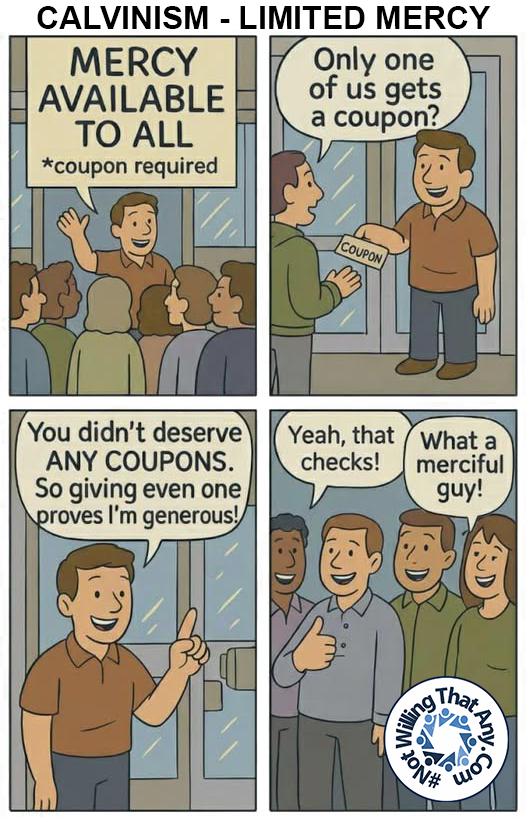
The goal of this illustration is to raise a real question while still being fair to Calvinism. Calvinists do not believe God is cruel or unjust. They believe all people deserve judgment because all have sinned. So if God saves even one person, they would say that is real mercy. The illustration is asking whether that idea of mercy matches the way mercy is usually shown in the Bible.
Total Depravity: The comic starts with the Calvinist idea that no one deserves mercy. That part matters. In Calvinism, all people are fallen and guilty before God. No one can demand salvation. That is why the speaker says no one deserved a coupon. The point is that mercy is undeserved. Calvinists often point to passages like Romans 3:10 to 12, Ephesians 2:1 to 3, and 1 Corinthians 2:14.
Unconditional Election: The one coupon stands for the Calvinist view that God chooses some people to receive saving mercy and not others. Calvinists would say God is free to do this because mercy is His to give. The illustration pushes back by asking whether mercy feels truly merciful when it is only given to a few while many others are left without help. Calvinists often point to passages like Romans 9:15 to 18, Ephesians 1:4 to 5, and John 6:37.
Limited Atonement: The sign says mercy is available to all, but a coupon is required, and only one person gets one. That pictures the concern many non-Calvinists have with Calvinism. The offer can sound broad, but the saving provision is limited. The comic is asking whether that fits the Bible’s picture of God as full of compassion and rich in mercy. Calvinists often point to passages like John 10:11, Matthew 1:21, and Acts 20:28.
In the end, the illustration is not mainly about whether anyone deserves mercy. Calvinists and non-Calvinists both agree that no one does. The real question is what mercy means. Is mercy simply giving help to some when none deserve it? Or does mercy also include a real desire to show compassion to all?