
Quick Take:
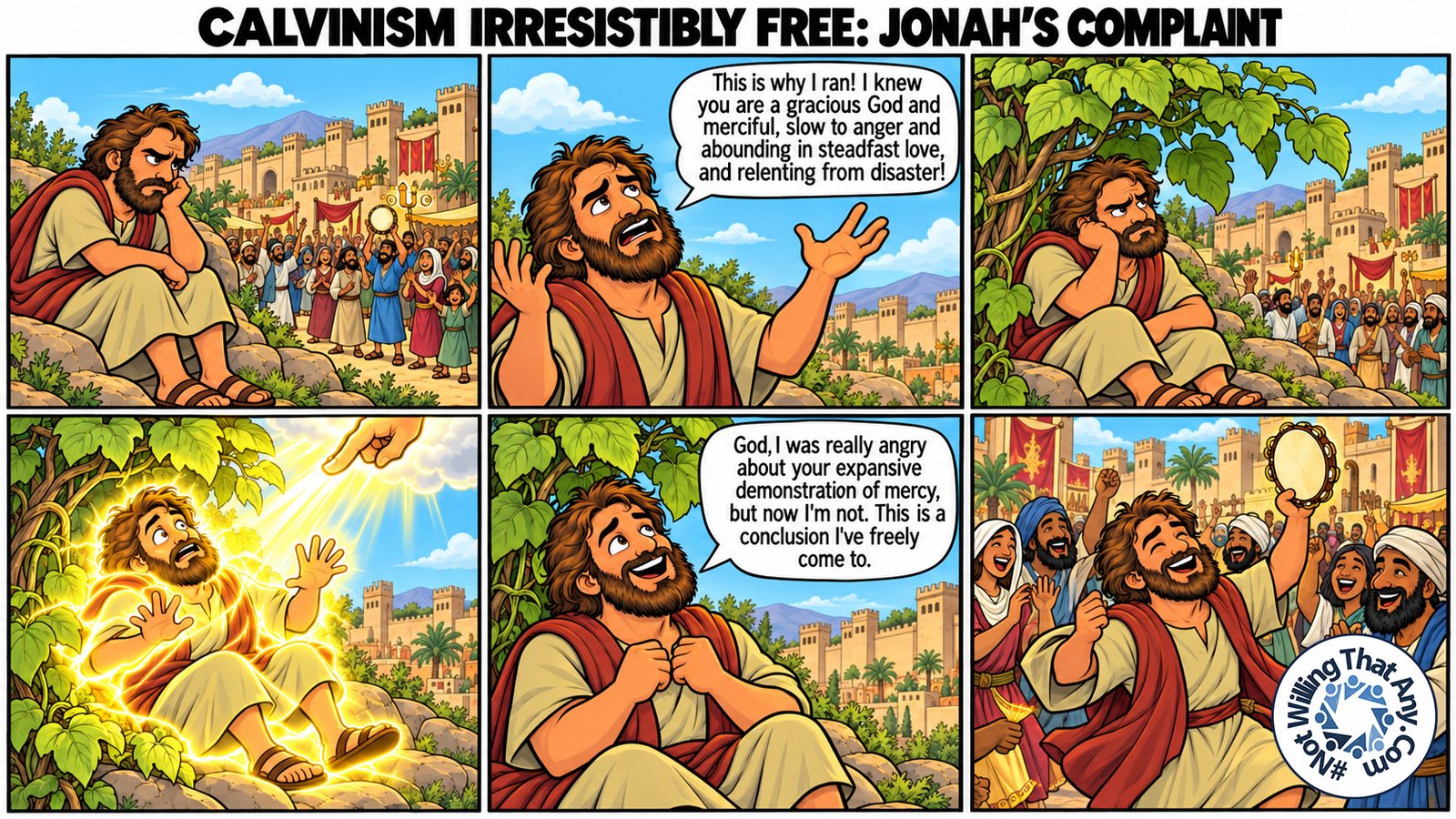
Why didn’t God just change Jonah’s mind? Both Calvinists and non-Calvinists agree that God has the power to accomplish His purposes. In Jonah’s story, God even controls the plant, the worm, and the wind. Yet Jonah remains angry about God’s mercy toward Nineveh. If God can irresistibly change a person’s desires while that person still freely chooses the outcome, why would God need to reason with Jonah? What would the story look like if God simply caused Jonah to freely embrace the very mercy he had been resisting?
Is it an accurate picture of Calvinism?
Full Analysis:
This illustration is not intended to mock Calvinism or suggest that Calvinists believe God literally zaps people into obedience. Rather, it asks what the Calvinist understanding of irresistible grace might look like if applied to Jonah’s attitude toward Nineveh. The goal is to consider whether this understanding of God’s work in the human will fits the way Scripture describes His interactions with people.
Irresistible Grace: Calvinists teach that when God effectually calls someone to salvation, He changes that person’s heart so they willingly come to Him. They often point to John 6:44 and Ezekiel 36:26–27 to support this view. The illustration takes this principle and applies it to Jonah’s anger. Rather than continuing to resist God’s mercy, Jonah suddenly desires what God desires. His change is certain because God has irresistibly changed his heart, yet Jonah considers his new attitude a free choice.
Unconditional Election: Calvinists understand God’s decision to save someone as resting on His own will rather than the person’s response or actions. Romans 9:16 is often used to support this understanding. In the illustration, Jonah’s change is not brought about by his own willingness to reconsider his attitude. God decides to change Jonah’s desires, and Jonah responds accordingly. Although election concerns salvation rather than every act of obedience, the illustration raises a related question about whose decision ultimately determines the outcome.
Total Depravity: Calvinists understand passages like Romans 8:7–8 and 1 Corinthians 2:14 to teach that fallen people cannot rightly respond to God apart from His grace. Jonah’s attitude certainly demonstrates how stubborn the human heart can be, even in someone who knows God. But the illustration raises a question about how God overcomes such resistance. Must He irresistibly change Jonah’s desires, or can God use His gracious dealings with Jonah to bring him to a point where he must decide how to respond?
A non-Calvinist would understand Jonah’s story differently. God does not simply leave Jonah to his anger. He gives Jonah a plant, appoints a worm, sends a scorching wind, and asks questions intended to expose Jonah’s wrong attitude (Jonah 4). God is actively working to change Jonah’s thinking through circumstances and instruction. Yet the book ends without telling us whether Jonah accepted God’s correction. We are left with God’s final question rather than Jonah’s final response. What makes the most sense of this account? If God could irresistibly change Jonah’s heart while preserving his freedom, why does Scripture show God reasoning with Jonah and leave us without a recorded response?