
Quick Take:
What does the Bible mean when it says someone is “dead”?
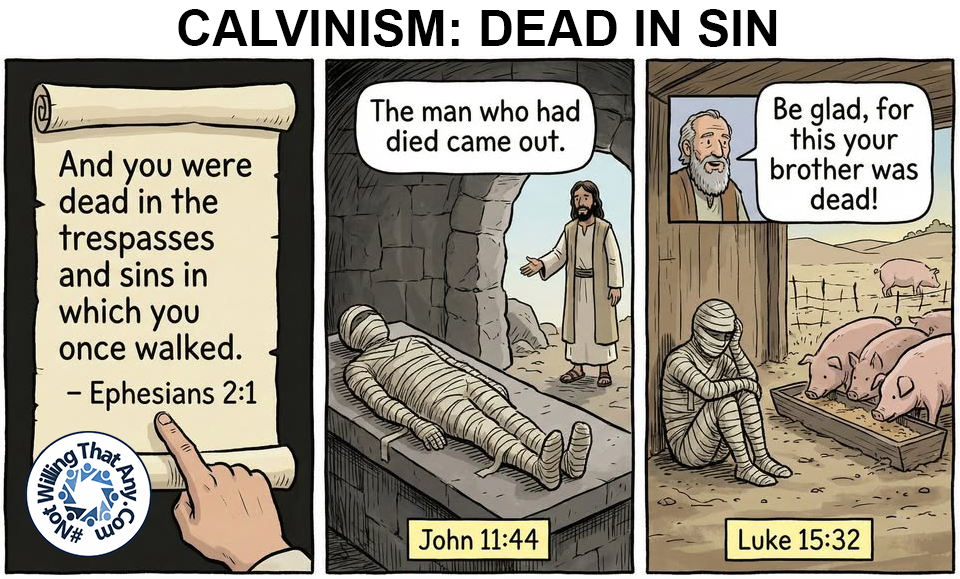
In Scripture, “dead” often does not mean non-existent or incapable of all response, but separated, ruined, under judgment, and unable to give oneself life. That is why the Bible can speak of people as “dead” while still describing them as walking in sin, like the prodigal son being “dead” and then “alive again,” or Lazarus being physically dead in a unique miracle scene. This illustration raises the question of whether Calvinism reads every use of “dead” in the strongest possible sense, when the Bible often uses the word in a relational, moral, or covenantal way rather than as a denial that God’s voice can be heard and answered.
Is it an accurate picture of Calvinism?
This illustration is trying to ask a fair question, not just score points. The goal is to ask what Calvinists mean when they say sinners are “dead in sin,” and whether that meaning matches the way the Bible uses the word dead. Like all illustrations, this one has limits. Still, it raises an important issue because Calvinism often builds a major part of its view of man’s inability on that one word.
Total Depravity: Calvinists often point to Ephesians 2:1 and say that being “dead in sin” means a sinner is spiritually unable to respond to God unless God first gives new life. They often connect this with passages like Romans 3:10 to 11, 1 Corinthians 2:14, and John 6:44. The illustration pushes back by showing that the Bible does not always use the word dead that way. In Luke 15:32, the prodigal son was called “dead” and then “alive again,” yet he was clearly still able to think, feel, and return. That suggests “dead” can mean separated, lost, ruined, or cut off, not necessarily incapable of responding to the Father.
Irresistible Grace and Regeneration First: Calvinism usually says that if a sinner is truly “dead,” then God must first make him alive before he can believe. That is why they connect this idea to passages like John 1:13, John 3:3, and Ephesians 2:4 to 5. But the Lazarus picture in John 11 may not prove that all spiritual deadness works exactly like physical death. Lazarus was a literal corpse, and Jesus performed a public miracle to show His divine power. Using that one miracle as the controlling picture for every call of the gospel may press the image too far, especially when other passages show God calling sinners to hear, repent, seek, and believe.
System Coherence: The illustration also questions whether Calvinism may flatten different kinds of “death” into one meaning. Physical death in John 11 is not identical to the relational death of the prodigal son in Luke 15, and neither should automatically define Paul’s meaning in Ephesians 2. Calvinists want to be faithful to the seriousness of sin, and that part should be respected. But the Bible often uses strong words in ways that stress man’s ruin and need, not necessarily his total inability to respond to a God who is seeking him through truth, conviction, and the gospel.
In the end, the illustration asks whether Calvinism’s reading of “dead” is too narrow and too absolute. Does it fit the whole Bible’s use of that word, or does it load more into the term than Scripture itself does? And when you see the practical picture this creates, does it feel like it matches the character of God as He reveals Himself in His calls, warnings, compassion, and appeals to sinners?