
Quick Take:
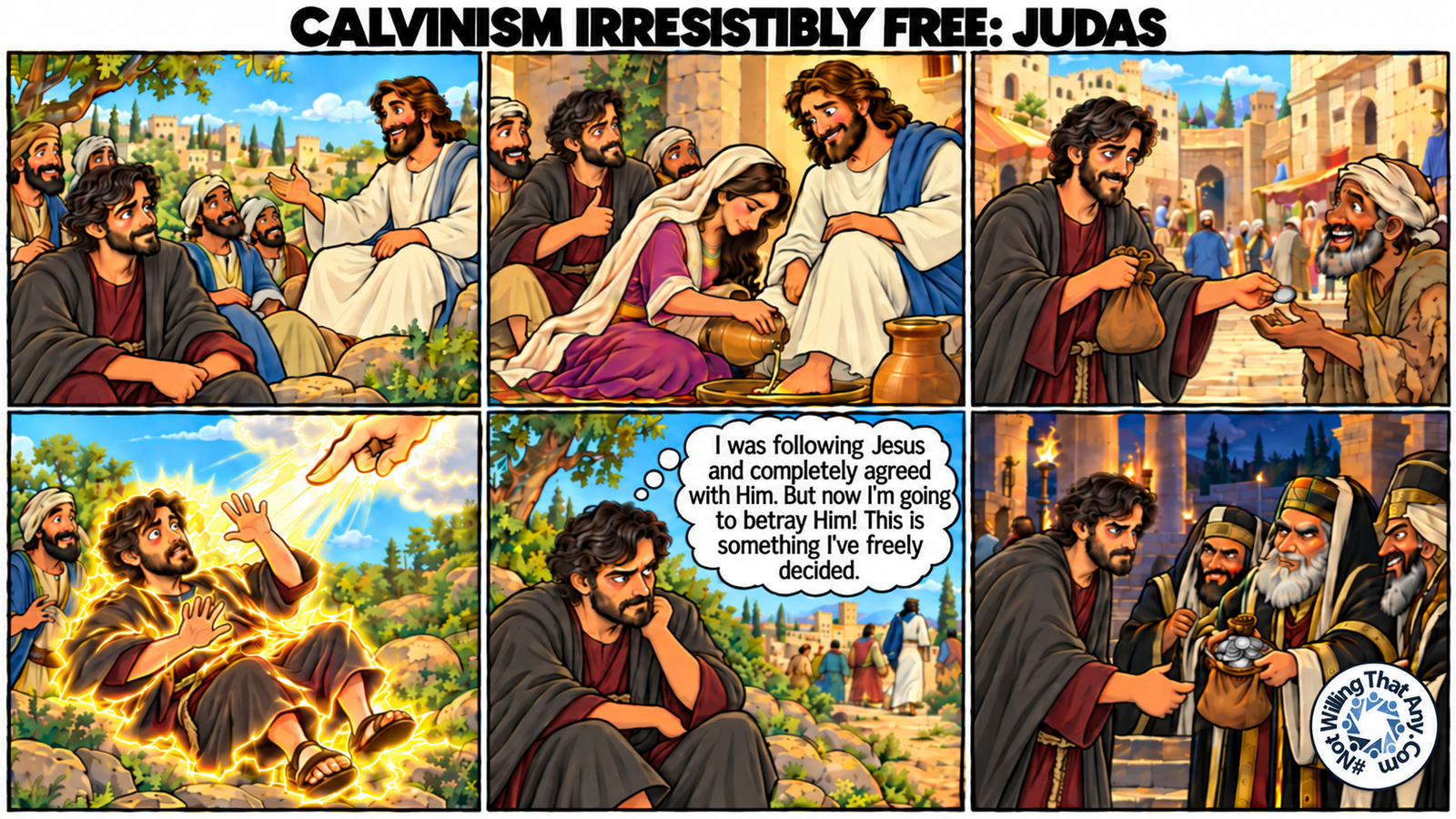
Did God change Judas, or did God work through Judas’s own desires? Both Calvinists and non-Calvinists agree that God was fully sovereign in the betrayal of Christ. But if Scripture meant to teach that Judas first truly agreed with Jesus and then was irresistibly moved to betray Him, what would that look like in the story? Would we expect to see a clear change of heart caused directly by God, or would we expect God to use Judas’s existing motives and choices? That is worth tracing carefully in the biblical text.
Is it an accurate picture of Calvinism?
Full Analysis:
This illustration is not meant to mock Calvinists. It is meant to ask whether a certain Calvinist way of explaining God’s sovereignty and human choice really fits what we see in the story of Judas. The point is not that Calvinists deny human responsibility. They do affirm that Judas acted willingly. The question is whether, in this case, Calvinism implies more than many readers notice when they say Judas acted freely.
Total Depravity. Calvinists often argue that fallen man does not move toward spiritual good on his own, citing texts like Romans 8:7–8 and 1 Corinthians 2:14. If that is so, then any real agreement Judas had with Jesus would have to come from God’s working, not from Judas alone. The illustration presses that point. If Judas once truly approved of Jesus and His ways, then that approval would also fall under God’s sovereign control.
Unconditional Election. Calvinists also stress that God’s saving purposes do not rest on human willing or running, but on His mercy, often pointing to Romans 9:16. In that framework, God’s plan for Judas was never uncertain. Judas was part of the ordained path to the cross. The illustration asks the reader to consider what that means at the level of Judas’s inner life. If God had determined the role Judas would play, how should we think about the desires that led him there?
Irresistible Grace. Calvinists usually use this point for God’s effectual call in salvation, with texts like John 6:37, 44 and Romans 8:30. Still, the wider Calvinist claim is that God can effectively bring about His purpose through willing human choices. That is where the illustration raises its question. If Judas moved from agreement to betrayal under God’s certain plan, was that simply God using Judas’s evil desire, or would it require God to bring about that willing betrayal in a stronger sense?
A non-Calvinist reads the Judas story differently. God foretold and used Judas’s betrayal, but Scripture points to Judas’s own greed, unbelief, and openness to evil rather than to an irresistible change worked in him by God. John 12:4–6 shows Judas’s selfishness, Luke 22:3 says Satan entered him, and Matthew 26:14–16 shows him going to the chief priests on his own. In this view, God was active the whole time, through Christ’s teaching, warnings, kindness, and even fulfilled prophecy, yet Judas still chose to turn away. So which reading better fits the story: that God sovereignly used Judas’s sinful heart, or that God irresistibly made Judas willing to betray the Son he had been following?