
Quick Take:
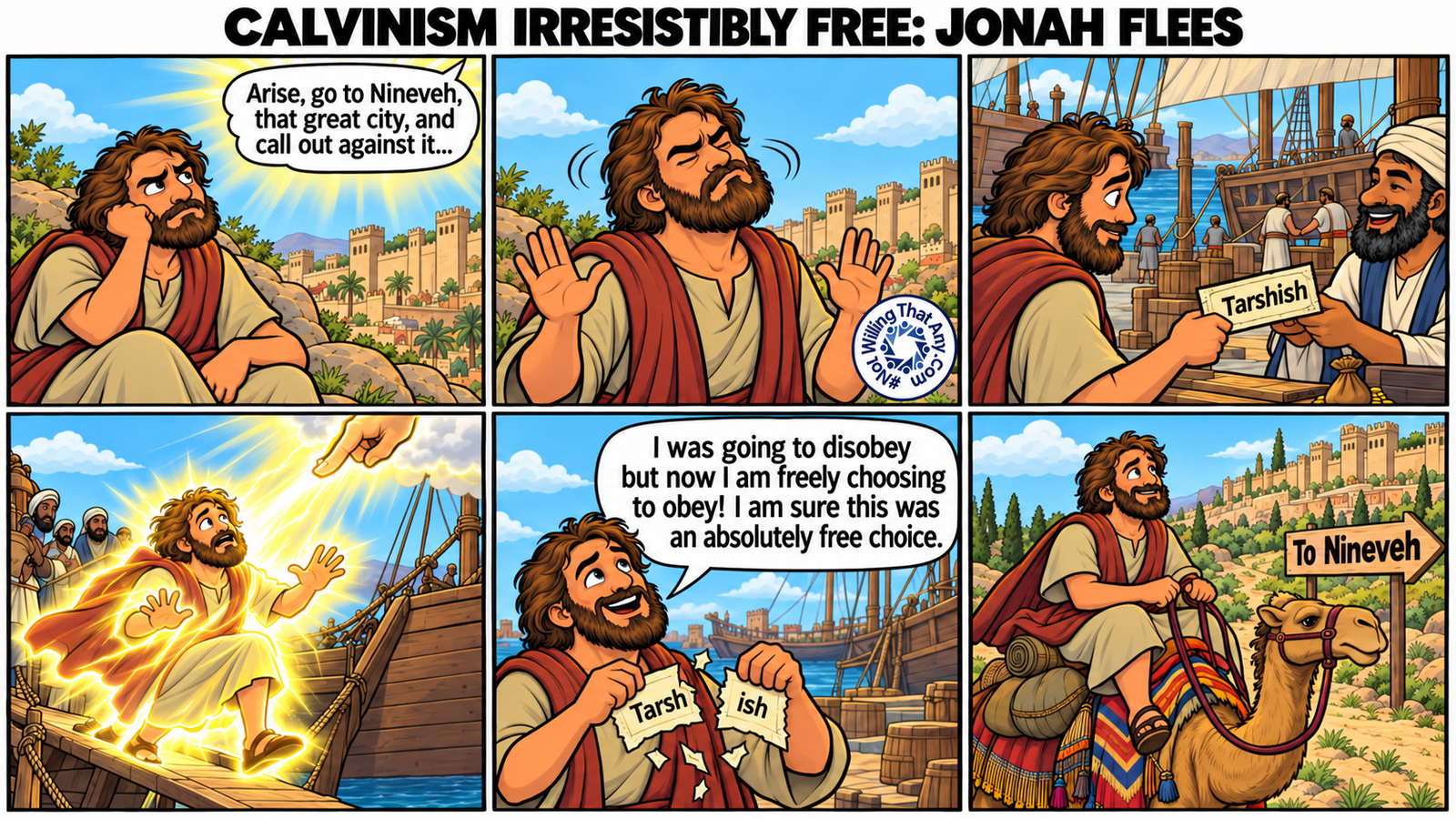
Does the ability for God to “irresistibly save” someone really exist? It is interesting to think through what the Bible would look like if God could irresistibly cause someone to freely change their minds. All parties acknowledge God’s ability to work through all situations to produce the outcomes He desires, but if God can irresistibly and freely change someone’s will, what would that situation look like?
Is it an accurate picture of Calvinism?
Full Analysis:
This illustration is not meant to mock Calvinists. It is trying to show, in simple picture form, how many non-Calvinists hear Calvinism’s claims about grace and human choice. The goal is not caricature, but to ask whether this is a fair summary of what irresistible grace sounds like when applied to Jonah.
Irresistible Grace: This is the clearest point in the illustration. Jonah is on his way to flee, and then God steps in and changes the outcome so Jonah will obey. That reflects the Calvinist idea that when God chooses to save or overcome resistance, His grace cannot finally be resisted. Calvinists often point to verses like John 6:37, John 6:44, and Ezekiel 36:26–27 to argue that God powerfully brings people to obedience.
Unconditional Election: The illustration also fits with the idea that God acts first, not because Jonah made the right choice on his own, but because God decided to do so. In Calvinist thought, God’s saving action does not rest on man’s will. Romans 9:16 is often used here: salvation “depends not on human will or exertion, but on God, who has mercy.” The picture of God interrupting Jonah’s rebellion lines up with that way of thinking.
Total Depravity: The illustration also assumes Jonah would keep going the wrong way unless God intervened. That matches the Calvinist belief that fallen man will not choose rightly apart from God’s special work in the heart. Calvinists often appeal to texts like Romans 3:10–12 and 1 Corinthians 2:14 to say that sinful man does not naturally submit to God. In that sense, Jonah’s refusal in the illustration is not just weakness, but inability apart from grace.
A non-Calvinist would read the story differently. He would say Jonah really could obey or disobey, and in fact the story shows that Jonah did freely resist God for a time. God used situations and circumstances to encourage Jonah to do what was right. Jonah, in a situation wherein he needed grace and mercy did accept God’s mercy (Jonah 2). However, if Jonah chose to refuse God’s command, he could have perished in the fish and received a just punishment for his disobedience. We have to ask ourselves what makes the most sense of the data? If God can irresistibly influence someone’s will AND have the influence be such where the person also freely chooses to obey, why do we not see the use of this more often in Scripture?