

Quick Take:
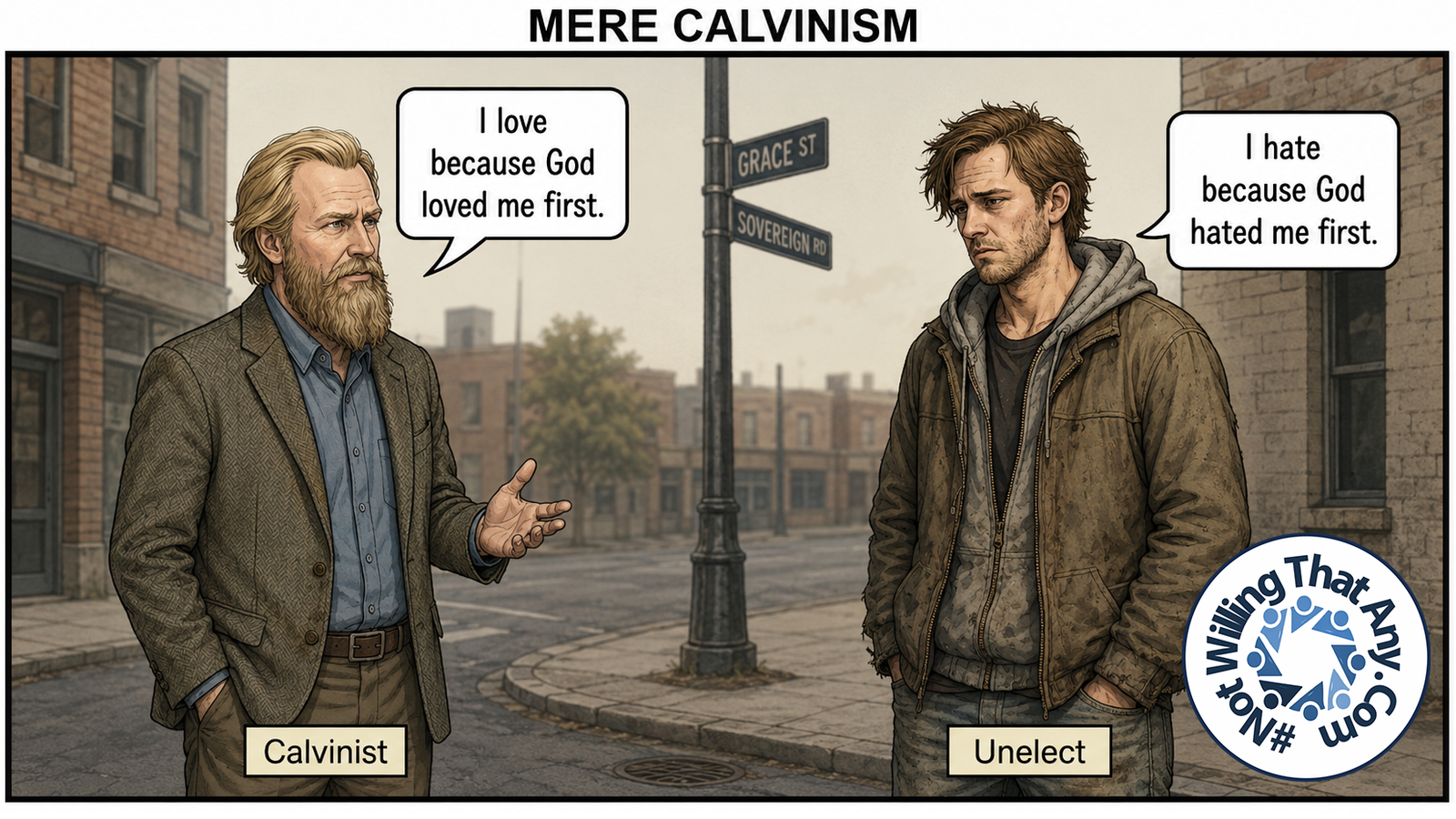
What’s the big difference between the unelect and the elect?
If God chooses to love you, you are enabled to love. If God chooses to hate you (via a Calvinist interpretation of Rom. 9:13), you are unable to respond to God’s salvific love, being trapped in the hate (via Total Depravity).
Is it an accurate picture of Calvinism?
Before critiquing any position, it is important to represent it fairly. Calvinists would not say that the unelect person’s hatred is caused in the same direct way that the elect person’s love is caused. Nevertheless, Calvinism does teach that the ultimate difference between the two people is found in God’s eternal decree and His decision to grant saving grace to some and not others. In that sense, this illustration seeks to highlight what many critics see as the practical implication of Calvinist theology.
Total Depravity
Calvinism teaches that fallen people cannot come to God on their own. The Calvinist loves God because God first changed his heart. The unelect person remains in unbelief because he has not received that same transforming grace. (John 6:44; Romans 3:10-12)
Unconditional Election
According to Calvinism, God chose certain individuals for salvation before creation, apart from anything they would do. The difference between the two men is therefore not found in themselves, but in God’s choice. (Ephesians 1:4-5; Romans 9:11-16)
Irresistible Grace
Calvinists believe that when God intends to save someone, His grace effectively brings that person to faith. The elect person will come to love God because God’s saving call accomplishes God’s purpose. (John 6:37; Romans 8:29-30)
The Biblical Portrait of God’s Love
Scripture repeatedly describes God as loving the world, desiring all people to be saved, and taking no pleasure in the death of the wicked (John 3:16; 1 Timothy 2:4; Ezekiel 33:11; 2 Peter 3:9). These passages present a God whose mercy extends to all people and whose invitation to salvation is sincere and genuine.