

Quick Take:
Who are we supposed to love and care for?
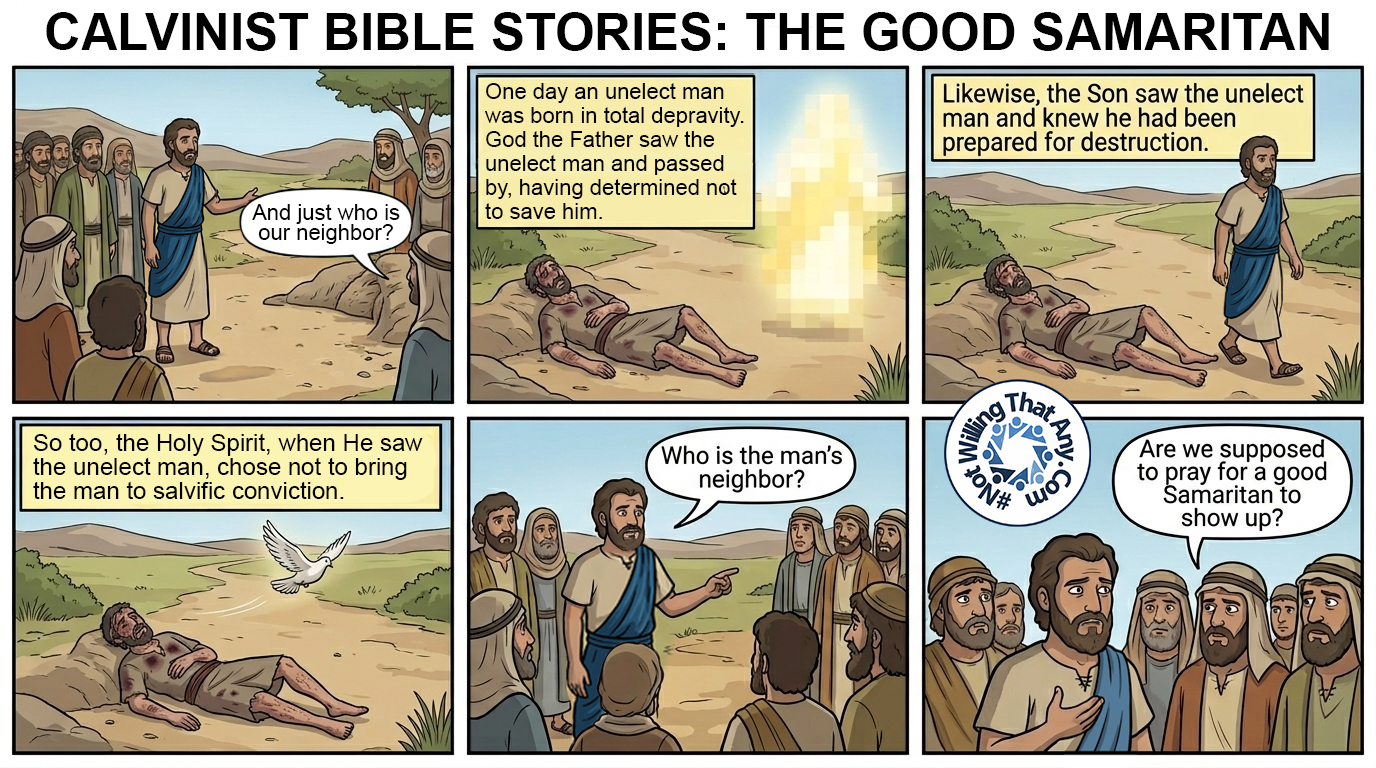
Jesus taught us to love our neighbor and show mercy to those in need. The Good Samaritan helps someone who cannot help himself. We are also told to pray for others and reach out with compassion. This illustration asks a hard question. If we are called to love and care for all people, what does it mean if God does not offer saving love to all?
Is it an accurate picture of Calvinism?
This illustration is aiming to reflect Calvinist theology as it is often presented, not misrepresent it. It places the Good Samaritan story inside that framework to show how key ideas would apply if carried into the parable.
First, this connects to the idea that God passes by the unelect. In Calvinism, God is not obligated to show saving mercy to everyone. Romans 9:18 says, “he has mercy on whomever he wills, and he hardens whomever he wills.” Just as the priest and Levite passed by in the original story, this illustration shows God passing by those He has not chosen, not out of injustice, but out of sovereign freedom.
Second, it reflects the belief that some are prepared for destruction. Romans 9:22 speaks of “vessels of wrath prepared for destruction.” In this view, those who are not elect are not simply left neutral, but are part of God’s larger plan to display His justice. The panel where the Son passes by highlights this idea. The man’s condition is not going to change because his outcome is already determined within God’s decree.
Third, it highlights the distinction between general love and salvific love. Calvinists often teach that God shows kindness and care to all people in a general sense (Matthew 5:45), but reserves saving love only for the elect. This is why, in the illustration, there is no rescuing action. The lack of intervention is not seen as a lack of all love, but specifically a lack of saving love.
This raises a key question. If this is an accurate picture of how these ideas work together, does it align with the kind of compassion Jesus is teaching in the Good Samaritan? Or does it invite a closer look at how we understand God’s love and mercy toward all people?