
Quick Take:
When something doesn’t make sense, is it mystery or contradiction?
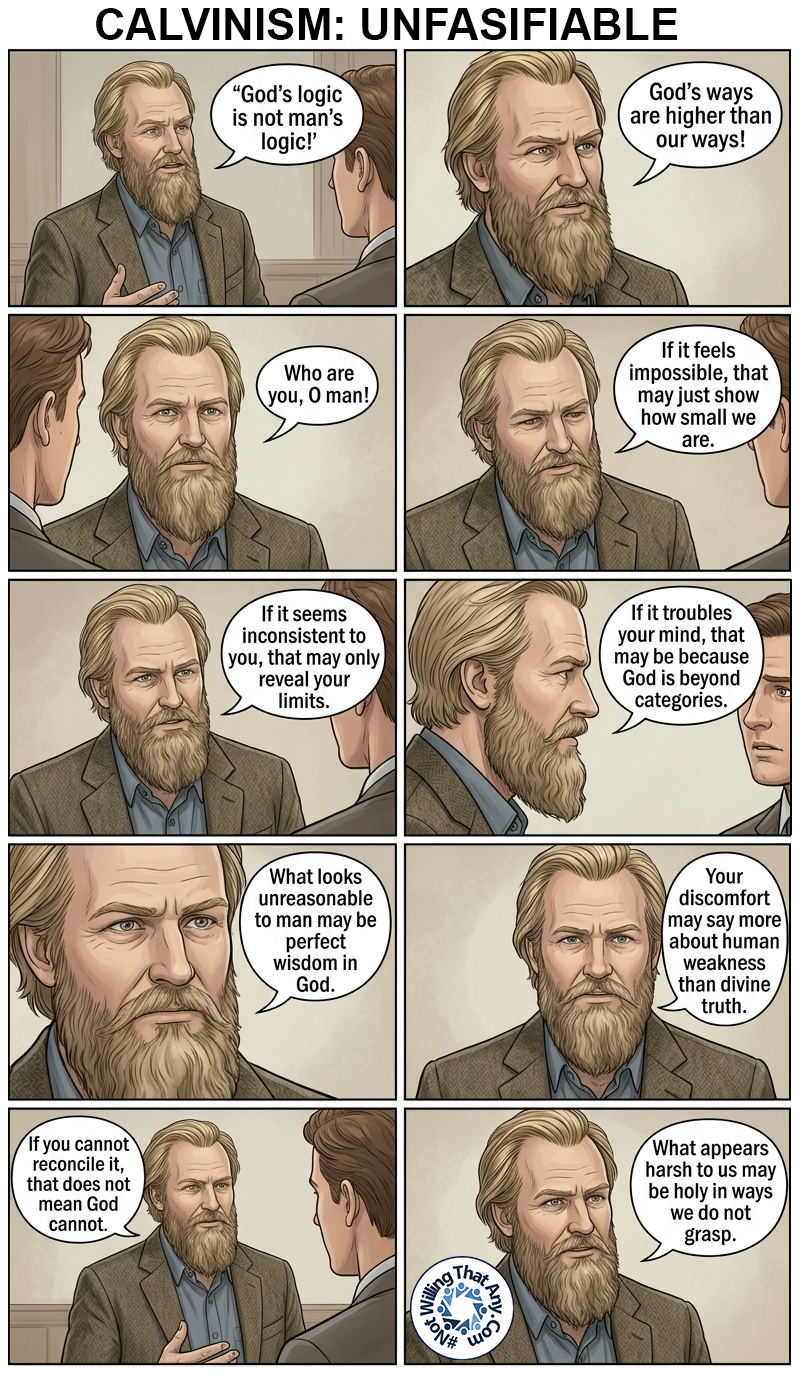
This illustration shows a pattern of responses. Each time a concern is raised, the answer shifts to God being beyond human reasoning. That can be true in some cases. But the picture raises a deeper question. Are we dealing with real mystery, or are we using mystery to avoid tensions that might need to be resolved?
Is it an accurate picture of Calvinism?
This illustration is aiming to reflect a real tension in Calvinist theology, not exaggerate it. It takes the idea of election and shows it visually in terms of proportion. One petal represents the elect, while many “nots” represent those passed over. The focus is on how small the number of the elect might be compared to everyone else.
First, this connects to limited atonement. In this view, Christ’s death is effective only for the elect, not for every individual. Passages like John 10:26, “you do not believe because you are not among my sheep,” and John 17:9, “I am not praying for the world but for those whom you have given me,” are often used to support this. The illustration reflects that by showing a small number who are truly loved in a saving sense, and many who are not.
Second, it ties to unconditional election and reprobation. God chooses some to receive mercy while others are passed over. Romans 9:13 says, “Jacob I loved, but Esau I hated,” and Romans 9:22 speaks of “vessels of wrath prepared for destruction.” The many “nots” in the image visually represent this larger group who are not chosen, emphasizing the imbalance.
Third, it reflects the idea that salvific love is not universal. While Calvinists affirm that God shows a kind of general love or kindness to all (Matthew 5:45), His saving love is reserved for a specific people. The illustration presses on that distinction by asking what it means in practice. If most people are not recipients of that saving love, then the experience of humanity is largely outside of it.
This leads to a key question. If Scripture says God “so loved the world” (John 3:16) and desires “all people to be saved” (1 Timothy 2:4), how should we understand the scope of His love? Does the picture of a few loved and many not align with the overall tone and message of the Bible, or should we rethink how we define God’s saving love?