
Quick Take:
If the patient cannot ask for the cure, and the doctor only heals those he has already chosen, who is ultimately responsible for his death?
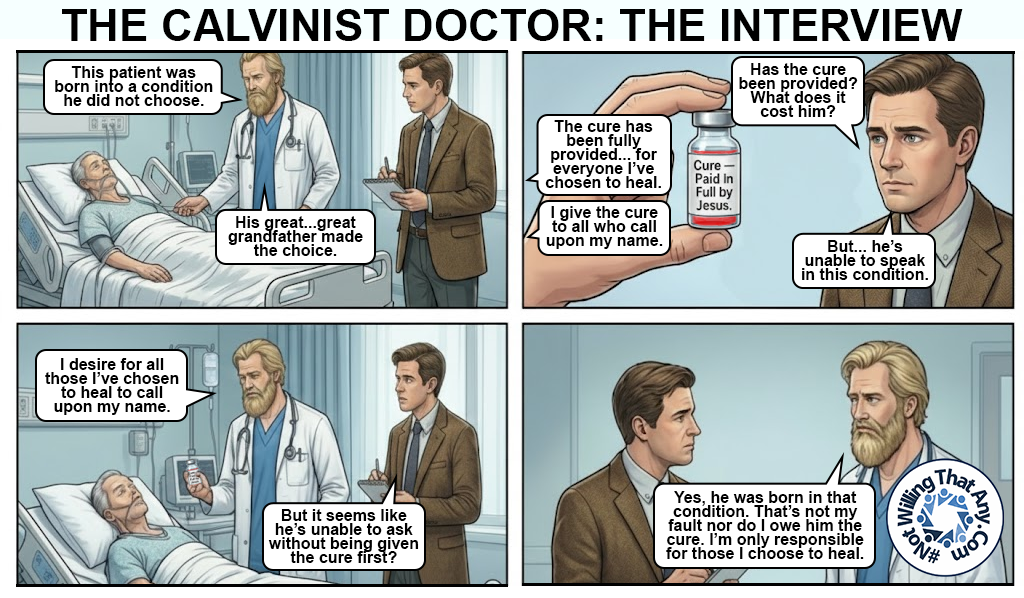
This illustration questions whether a system that limits who receives healing can truly reflect a God who sincerely desires all to be saved. It presses on the tension between provision and access, between ability and responsibility.
Is it an accurate picture of Calvinism?
First, this illustration is not meant to mock Calvinism or portray it as cruel for shock value. It is trying to visualize, in concrete terms, what classic Reformed theology teaches about Total Depravity, Unconditional Election, and Limited Atonement. The patient’s condition represents inherited spiritual inability. The doctor represents God. The interview format simply draws out the logical implications of those doctrines in a human setting so we can see them more clearly.
Total Depravity:
The patient “was born into a condition he did not choose.” That reflects the Calvinist understanding of inherited sin and moral inability. Passages often cited include Romans 3:10–12, Ephesians 2:1–3, and John 6:44. In this view, the patient cannot speak, ask, or respond unless first enabled. The illustration captures this by showing the man unable to call out for the cure on his own.
Unconditional Election:
The doctor says the cure is for “everyone I’ve chosen to heal.” That reflects the idea that God’s saving choice is not based on foreseen faith but on His sovereign will. Calvinists commonly point to Romans 9:15–18 and Ephesians 1:4–5. The grandfather’s choice in the image symbolizes federal headship, similar to how Adam’s sin is understood to affect humanity in Romans 5:12–19. The system is consistent within its framework: the doctor heals whom he wills.
Limited Atonement and Effectual Calling:
The bottle labeled “Paid in Full by Jesus” acknowledges that Christ’s work is sufficient and decisive. Calvinists often appeal to John 10:14–15 and Matthew 1:21 to argue that Christ died specifically for His sheep and will certainly save them. The statement “I give the cure to all who call upon my name” mirrors Romans 10:13, but within Calvinism, only the elect will be enabled to call. The tension highlighted is that the call appears universal, yet the ability to respond is limited to those already chosen.
The emotional weight of the illustration comes from the final exchange: the doctor says he desires those he has chosen to call, yet the patient cannot call unless first healed. The question raised is whether this reflects the character of God as revealed in passages like 1 Timothy 2:4, 2 Peter 3:9, and Ezekiel 18:23, where God expresses desire for repentance and life rather than death?