
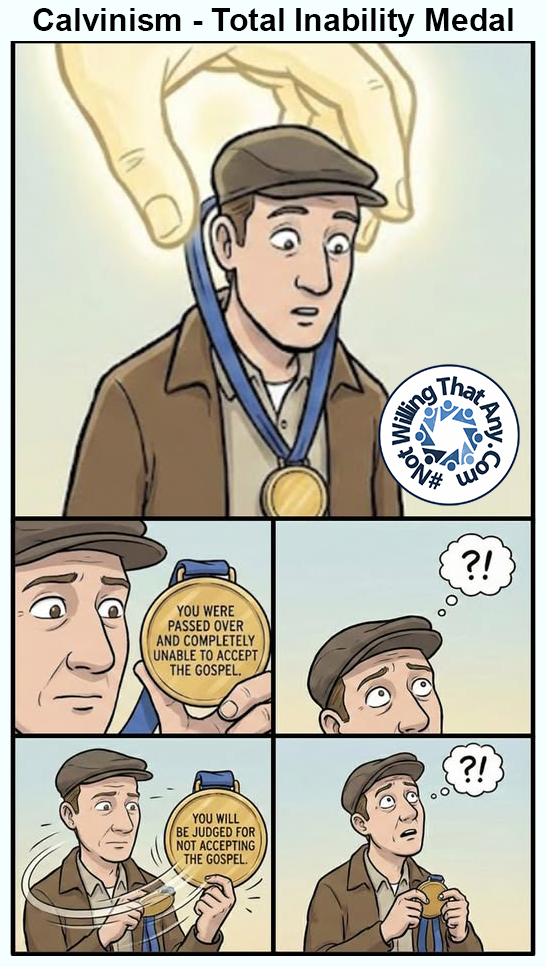
Quick Take:
If a person is truly unable to accept the gospel, in what sense can they still be held responsible for not accepting it?
This illustration raises that question by placing inability and judgment side by side. It is not asking whether people are sinful or whether grace is necessary. It is asking how moral responsibility works when acceptance is said to be impossible from the start.
Is it an accurate picture of Calvinism?
This illustration is meant to show Total Inability as it is taught within Calvinist theology. It is not meant to exaggerate the doctrine, but to picture it clearly. The medal represents a verdict handed down by authority, not something the man earned. Each part of the illustration reflects claims Calvinists make directly from Scripture.
Total Inability:
Calvinism teaches that fallen humans are unable to come to Christ unless God first enables them. This is based on passages like John 6:44, where Jesus says, “No one can come to me unless the Father who sent me draws him,” and Romans 8:7–8, which says the flesh “does not submit to God’s law; indeed, it cannot.” Because of this, unbelief is not just a choice but the result of moral inability. The medal’s statement, “You were passed over and completely unable to accept the gospel,” reflects this teaching. The man’s confusion matches the idea that this condition is inherited and not personally chosen (cf. Psalm 51:5).
Judgment Despite Inability:
At the same time, Calvinism teaches that people are still judged for unbelief. Jesus says in John 3:18 that whoever does not believe “is condemned already,” and Paul speaks of judgment on those who suppress the truth in Romans 1:18–20. Even though people are unable to believe apart from grace, they are still held responsible. This is often defended using Romans 9:19–21, where Paul responds to the objection, “Why does he still find fault?” by appealing to God’s authority as Creator. The second message on the medal shows this clearly: inability and judgment are declared together.
God’s Sovereignty and Human Responsibility:
Calvinism argues that God’s sovereign choice determines who receives saving grace (cf. Ephesians 1:4–5; Romans 9:22–23), and that this does not make God unjust. The illustration reflects this by showing both messages coming from the same source. The man is not judged for rejecting grace offered to him, but for failing to believe at all. The question marks in the final panels represent the tension many feel when reading these passages together. Scripture affirms both God’s control and human accountability, but the illustration asks how those ideas fit together in practice.
Taken as a whole, the illustration accepts the Calvinist use of Scripture on human inability, election, and judgment. It does not deny sin, grace, or God’s authority. Instead, it invites reflection on whether this combination of teachings presents a picture of justice that aligns with the character of God as revealed throughout Scripture. When these doctrines are followed all the way through, does this outcome make sense of responsibility, or does it raise deeper questions that deserve careful thought?
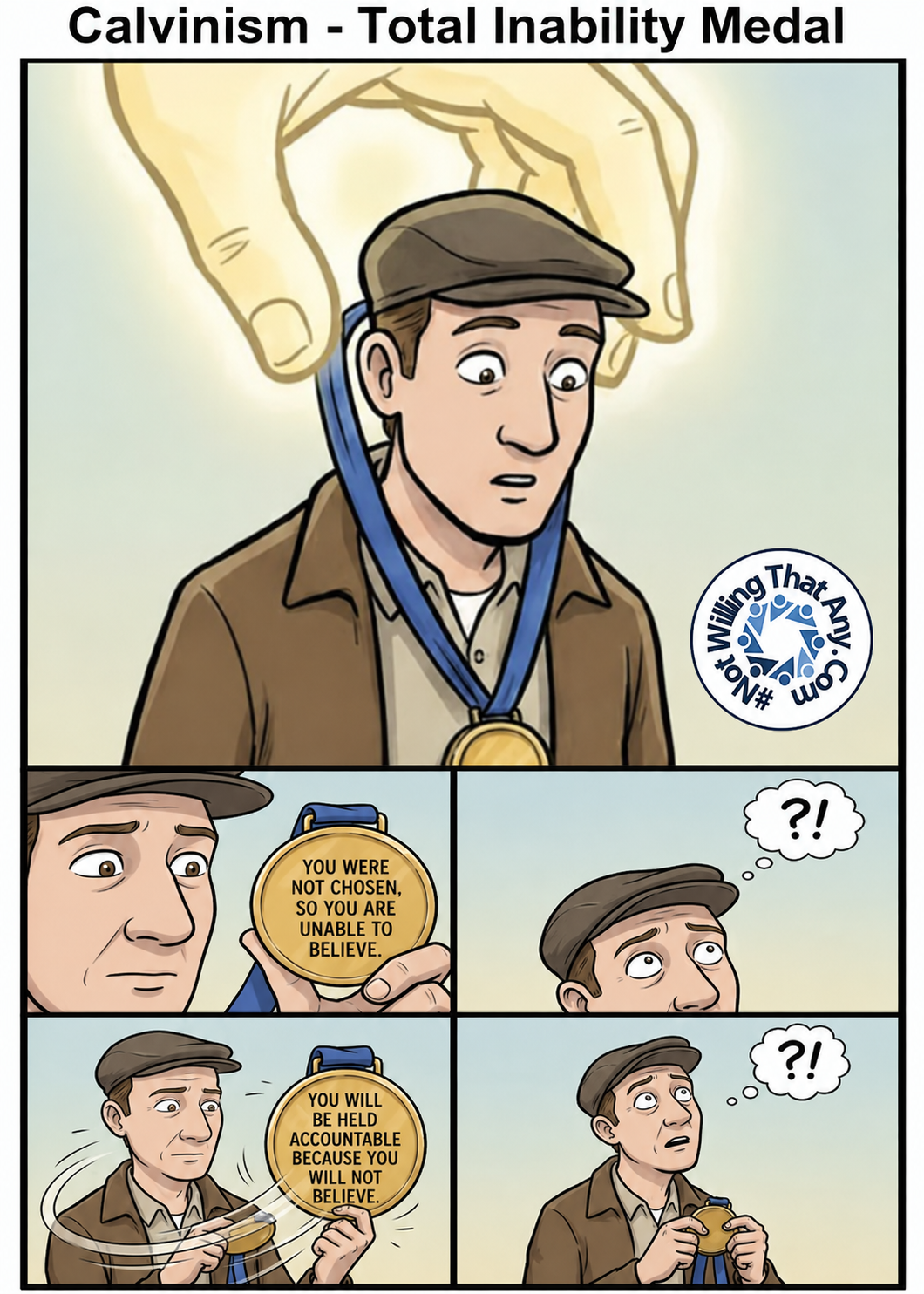
This is the second version of the illustration. The wording was changed to better represent what Calvinists believe following conversations after the first one was posted. The first version said the person would be judged for “not accepting the Gospel,” which a Calvinist typically rejects by saying that people are judged for their sin, not simply for failing to accept the Gospel.
The revised wording keeps the real tension in view without overstating the Calvinist position: the person is not chosen and therefore is unable to believe, yet he is still held accountable because he will not believe. The point is to show the relationship between inability and responsibility in a way that a Calvinist would recognize as a fairer description of the position.