
Quick Take:
What happens when divine judgment is explained as a result of withheld ability rather than rejected grace?
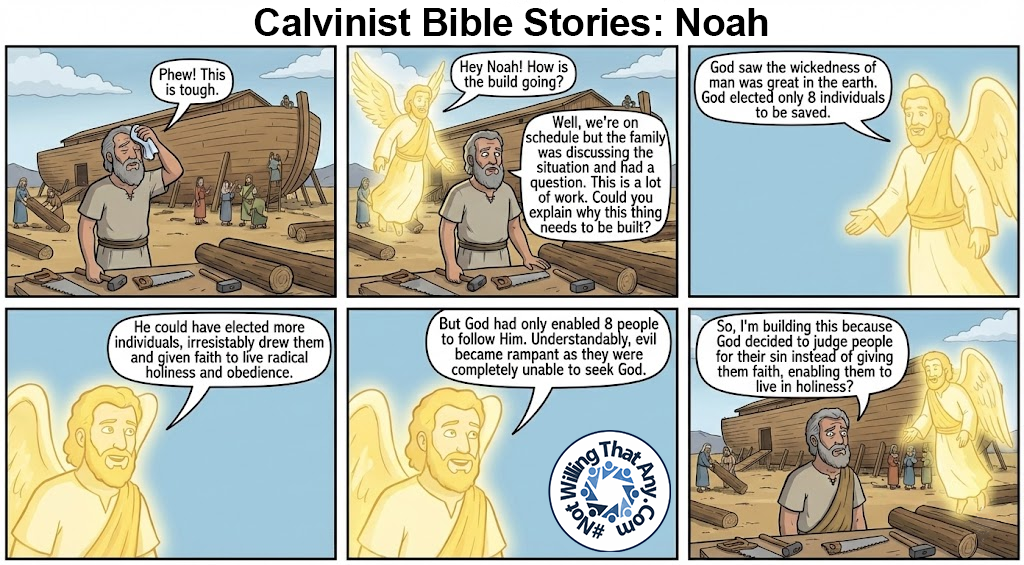
This illustration presses that question by placing Noah in the middle of intense obedience while being told that the surrounding world never had the capacity to respond differently. The tension is not whether God judges sin Scripture clearly affirms that He does but whether the moral logic of judgment still resonates when faith itself is selectively granted. By visualizing the explanation out loud, the illustration invites the viewer to consider whether this framing aligns with their understanding of God’s justice and goodness.
Is it an accurate picture of Calvinism?
This illustration is offered as a good faith attempt to represent Calvinist theology as it explains the flood narrative. It does not deny sin, human wickedness, or God’s right to judge. Instead, it takes Calvinist categories seriously and asks what they sound like when spoken plainly, without caricature, in the middle of a familiar Bible story.
Total Depravity:
The angel’s explanation that humanity was “completely unable to seek God” reflects the Calvinist understanding of total depravity. Passages such as Genesis 6:5 and Romans 3:10–11 are commonly cited to show that fallen humans do not and cannot seek God on their own. The illustration faithfully represents this by grounding the flood in moral inability rather than mere bad choices.
Unconditional Election:
The repeated emphasis on “only eight individuals” being elected mirrors the Calvinist claim that God’s choice of the saved is not based on foreseen faith or response. This aligns with texts like Ephesians 1:4–5 and Romans 9:15–16, where election is rooted solely in God’s will. The illustration accurately portrays this by showing election as decisive and numerically fixed.
Irresistible Grace:
The angel’s statement that God “could have elected more, irresistibly drew them, and given faith” reflects classic Calvinist teaching that saving grace is effectual and unfailing for the elect. John 6:37 and John 6:44 are often used to support this idea. The illustration accepts this premise and builds on it rather than disputing it.
The closing panel intentionally leaves the viewer with Noah’s unresolved question. If people were judged while lacking the God given capacity to respond in faith, does that account of justice sit comfortably with the character of God as revealed elsewhere in Scripture? If this illustration accurately reflects Calvinist theology, is this a picture of divine judgment you ultimately find compelling and consistent with God’s goodness?