
Quick Take:
What happens when one original choice fixes the nature of everyone who comes after?
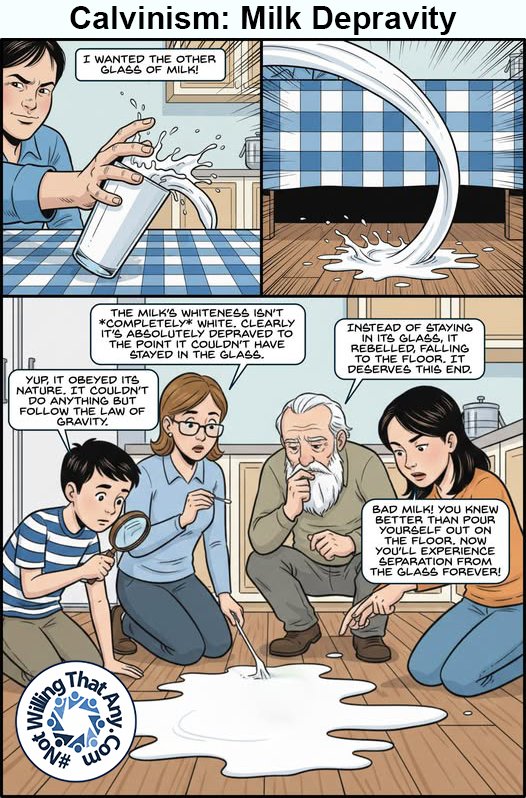
This illustration visualizes the Calvinist claim that Adam’s first act did not merely influence humanity but decisively determined its moral nature. Once that nature is set, every descendant necessarily follows it, not by repeating Adam’s choice, but by acting in line with what they already are. The image asks whether moral responsibility still functions the same way when the decisive moment occurred before any individual existed.
Is it an accurate picture of Calvinism?
This illustration is offered as a good faith attempt to represent Calvinism accurately rather than to mock or exaggerate it. The goal is to take Calvinist claims seriously and to visualize them as they are commonly explained in Scripture and theology. Any discomfort that arises is meant to come from the doctrine itself when seen plainly, not from distortion or hostility.
Total Depravity
The illustration reflects the Calvinist understanding that Adam’s fall decisively corrupted human nature. Once Adam sinned, all his descendants inherited that condition, so that every action flows from a fallen nature rather than from neutrality. This aligns with Romans 5:12, which teaches that sin entered the world through one man and spread to all men. Like the milk that can no longer remain upright, humanity does not freshly choose its nature but acts in accordance with what it already is.
Federal Headship
Adam is shown as the representative whose single act determines the standing of those who follow him. Calvinism teaches that Adam acted as the covenant head of humanity, so his guilt and corruption are imputed to his descendants. This corresponds with Romans 5:18, where one trespass leads to condemnation for all men. The illustration captures this by placing the decisive choice entirely in the first panel and binding every later outcome to that moment.
Moral Inability
The milk is described as incapable of doing otherwise because of what it has become. In the same way, Calvinism teaches that fallen humans are morally unable to choose God apart from divine intervention. Passages like Romans 8:7 state that the mind set on the flesh does not submit to God and indeed cannot. The illustration portrays this inability not as coercion but as necessity. The milk follows gravity because that is now its nature, just as fallen humans follow sin because of theirs.
If this illustration faithfully represents how Adam’s choice establishes human nature, moral inability, and inherited condemnation in Calvinist theology, the remaining question is whether this is a picture you are ultimately comfortable affirming once it is seen rather than merely stated.
Interesting Feedback:
RESPONSE: Theology Should Stand in the Open
Christian theology is not meant to be hidden, delayed, or protected from inspection. Scripture consistently presents God’s truth as something spoken plainly and publicly. Paul says that believers should renounce secrecy and distortion and instead commend the truth openly to everyone’s conscience (2 Cor. 4:2). This assumes that doctrine can be examined, questioned, and understood in the open, not reserved for a later stage or a smaller group. If a belief cannot be clearly described in front of unbelievers, that problem lies with clarity, not with spiritual maturity.
The Bible’s language about “milk” and “meat” is often misunderstood. In Hebrews, the issue is not that some doctrines are too dangerous or advanced to share, but that some believers have failed to grow in obedience and discernment (Heb. 5:12–14). The “meat” of the Word is deeper alignment with what God has already revealed, not secret knowledge introduced later. Scripture itself is public revelation. It is preached openly, read openly, and tested openly.
This openness is reinforced by the example of the Bereans, who were praised for examining the Scriptures daily to see whether what they were hearing was true (Acts 17:11). Their careful testing was not treated as rebellion or immaturity, but as faithfulness. Christian teaching, by design, invites scrutiny. Growth happens not by withholding theological clarity, but by returning again and again to God’s Word, allowing it to shape belief and life more fully.
In this sense, theology does not belong to a guarded inner circle. It belongs in the light. The gospel is proclaimed to all, and the doctrines that flow from Scripture must be able to endure honest examination by anyone who hears them.