
Quick Take:
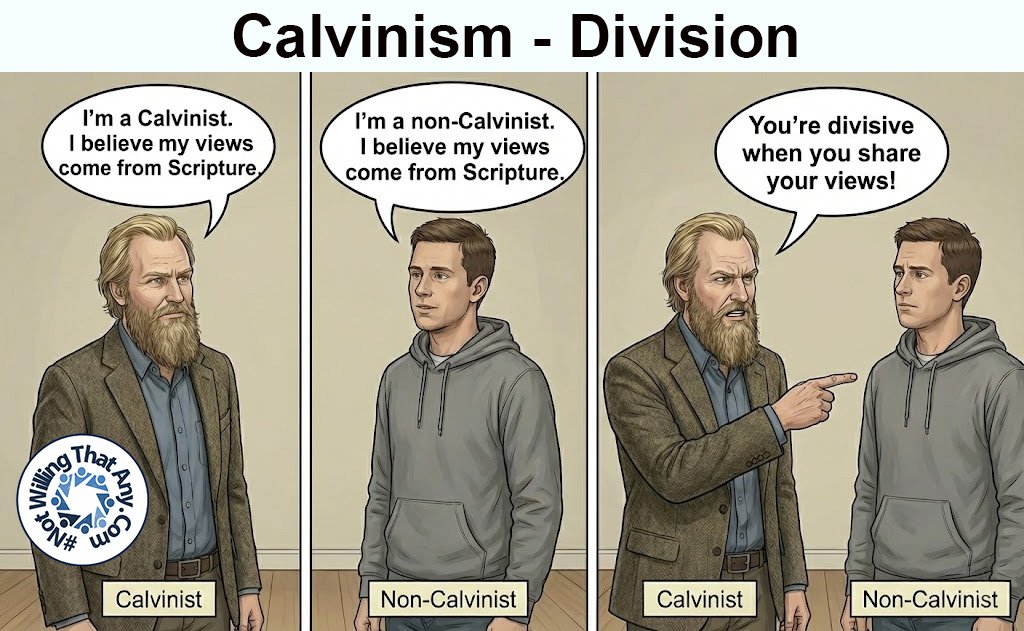
Why was this illustration created in the first place?
This illustration exists to address a repeated pattern in theological discussions where Calvinists often accuse non Calvinists of being divisive simply for expressing disagreement. Scripture makes room for disagreement among believers without equating it to sin or schism. “As for the one who is weak in faith, welcome him, but not to quarrel over opinions” (Romans 14:1, ESV). Paul distinguishes between disagreement and quarrelsomeness, showing that difference itself is not the problem.
Disagreement is not division.
The New Testament assumes faithful believers will disagree and still remain united in Christ. “For there must be factions among you in order that those who are genuine among you may be recognized” (1 Corinthians 11:19, ESV). Disagreement can actually reveal faithfulness rather than undermine it when handled rightly.
Division comes from pride, not position.
James locates the source of conflict not in theology but in the heart. “What causes quarrels and what causes fights among you? Is it not this, that your passions are at war within you?” (James 4:1, ESV). Division erupts when desires for control, vindication, or superiority are allowed to rule the conversation.
We must see one another as brothers in Christ.
Even sharp disagreement is meant to occur within the bonds of shared identity. “So then you are no longer strangers and aliens, but you are fellow citizens with the saints and members of the household of God” (Ephesians 2:19, ESV). The way believers speak to one another should reflect family loyalty, not adversarial suspicion.
This illustration is not a call to lower convictions, but a call to examine how those convictions are carried in relationship with other believers. Scripture does not equate disagreement with division, locates real conflict in prideful desires, and insists that brothers in Christ be treated as family even when differences remain. The invitation here is for Calvinists to consider whether unity is being protected not by silencing disagreement, but by practicing humility, charity, and shared allegiance to the Gospel. A commitment to unity is not proven by the absence of tension, but by the presence of love when tension arises.