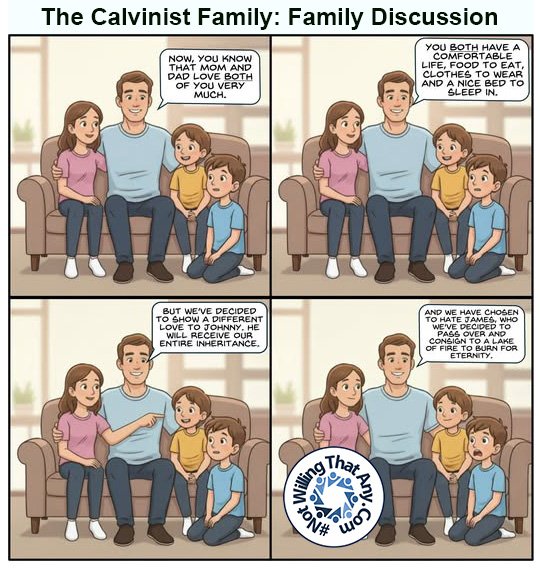
The goal of this illustration is to represent Calvinism as fairly and accurately as possible. No illustration can capture every detail of a theological system, but a good illustration can show how those beliefs work when applied to real relationships. This picture is not meant to accuse motives or mock faith. It simply asks what Calvinist doctrines look like when translated into everyday terms we understand, like a family and an inheritance.
Total Depravity
In Calvinism, all people are born spiritually dead and unable to choose God on their own. No child in the illustration earns the inheritance or reaches for it by themselves. This fits the Calvinist view that fallen humanity cannot move toward God without grace. Passages often cited include Ephesians 2:1–3 and Romans 3:10–12, which describe humanity as dead in sin and unable to seek God. The illustration reflects this by showing that nothing the children do affects the parents’ decision.
Unconditional Election
The parents’ choice to give the inheritance to only one child reflects unconditional election. The decision is made ahead of time and is not based on behavior, effort, or response. Calvinists often point to Romans 9:11–16, where God’s choice is said to depend not on human will or effort but on God’s mercy. In the illustration, the child who receives the inheritance does so only because the parents chose them, not because they were better or more willing.
Limited Atonement
The inheritance represents the saving benefits of Christ. In Calvinism, Christ’s atonement is effective only for the elect. While both children are loved in real ways and receive many good gifts, only one is given what matters most. Calvinists commonly appeal to passages like John 10:14–15 and Matthew 1:21, which speak of Christ laying down His life for His sheep and saving His people from their sins. The illustration shows provision for both children, but salvation-level provision for only one.
A Calvinist may say this illustration breaks down because it uses a family, and Scripture teaches that people are not part of God’s family until they are adopted through salvation. In that sense, the objection is correct. Not all humans are God’s children in the redemptive sense. However, the illustration is not claiming universal adoption. It is highlighting a real and biblical connection that exists before salvation. Scripture teaches that all people are God’s image bearers and His offspring by creation. In Acts 17:29, Paul says, “Being then God’s offspring, we ought not to think that the divine being is like gold or silver or stone.” This statement is made to unbelievers, showing a real relationship grounded in creation, not redemption. The family image is used to reflect that natural connection between God and those made in His image, not to argue that all are already saved.
The question the illustration raises still stands. If God is the Creator and Father in this foundational sense, how does a predetermined decision to withhold salvation from some of His image bearers reflect His character?