
Quick Take:
If God’s mercy is unlimited in power but limited in scope, how small does that mercy end up looking within Calvinism?
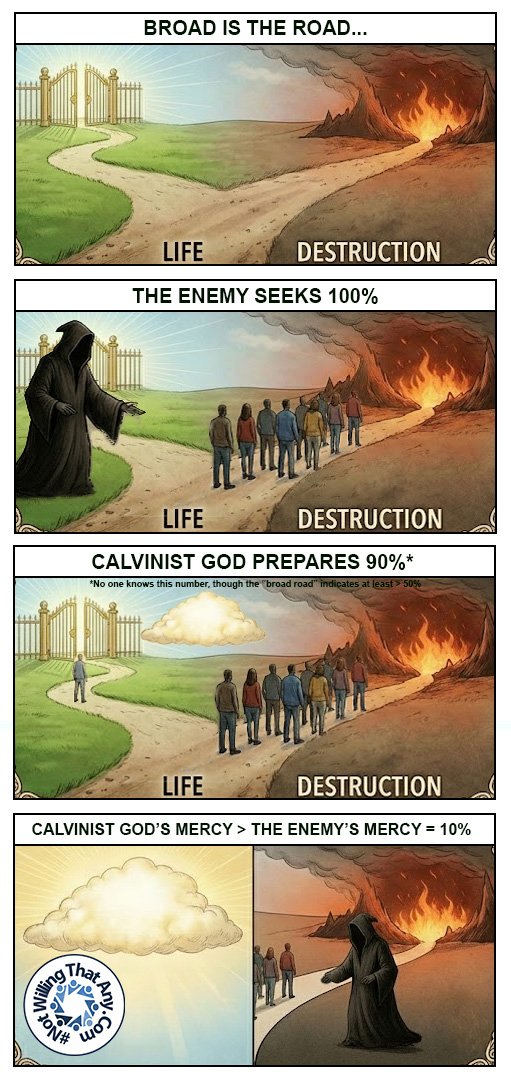
The panels raise a simple contrast. Scripture says the enemy seeks total destruction, yet when the road imagery is quantified, the system appears to portray God as intentionally preparing fewer for life than the enemy draws toward destruction. The force of the image is not the math itself but the comparison it invites between divine mercy and the enemy’s success.
Is it an accurate picture of Calvinism?
This illustration is not attempting to caricature Calvinism but to present its internal logic as accurately as possible and then let that logic be weighed against Scripture. The aim is correspondence, not exaggeration. When Calvinist doctrines are placed alongside Jesus’ “broad road” language, the tension that emerges is not emotional but theological.
1. Total Depravity:
Calvinism teaches that all people are born unable to respond positively to God apart from regenerating grace. This aligns with passages like Ephesians 2:1 and Romans 3:10–12, which describe humanity as spiritually dead and unrighteous. In the illustration, those walking the broad road are not merely choosing destruction but are unable to do otherwise unless God intervenes. This reflects Calvinism accurately. The tension arises when Jesus’ warning in Matthew 7:13–14 is read as a moral appeal to hearers who are simultaneously incapable of responding to that warning.
2. Unconditional Election:
The illustration’s depiction of God preparing only some for life corresponds to unconditional election, where God chooses individuals for salvation apart from any foreseen faith or response (Romans 9:11–18; Ephesians 1:4–5). The image does not claim exact percentages but visually communicates what “few” must mean in contrast to “many.” If God alone determines who leaves the road to destruction, then the final distribution reflects not human resistance but divine selection. That implication follows directly from the doctrine itself.
3. Limited Atonement:
By showing mercy applied to a smaller group while the majority remain on the road to destruction, the illustration reflects the Calvinist claim that Christ’s atoning work was intended only for the elect (John 10:15; Matthew 1:21). This creates the comparative tension highlighted in the final panel. Scripture says the enemy seeks total destruction (John 10:10; 1 Peter 5:8), while Calvinism affirms that God could save all but chooses not to. When outcomes are compared, the enemy’s destructive reach appears broader than God’s merciful intent, not because mercy is weak, but because it is deliberately restricted.
The illustration presses one central question. Scripture repeatedly describes God as desiring all to be saved and not wishing that any should perish (Ezekiel 18:23; 1 Timothy 2:4; 2 Peter 3:9). If a theological system results in a picture where God’s expressed desire is overridden by a narrower secret will, should that system be reconsidered in light of the biblical testimony about God’s character, His invitations, and His heart toward the world?