
Quick Take:
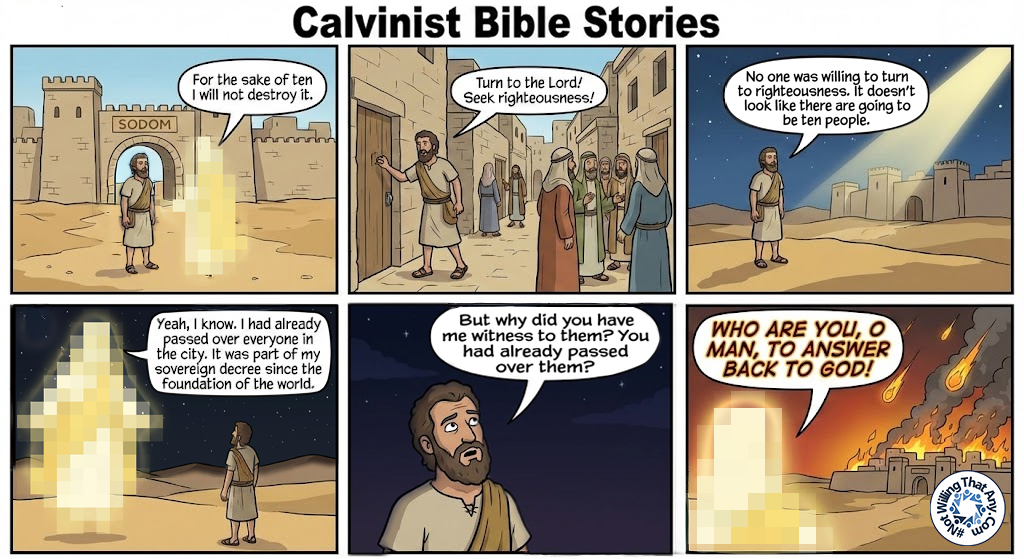
What if God’s expressed willingness to spare is paired with a prior certainty that no one will respond?
This illustration presses on a tension many readers feel when universal sounding appeals are filtered through a fixed decree. Abraham is shown pleading, God is shown speaking in conditional terms, and yet the outcome is framed as settled before the conversation begins. The point is not to mock divine sovereignty, but to ask whether the language of seeking, turning, and intercession functions meaningfully if the result is already inaccessible. When the story is told this way, the invitation feels real in words but closed in outcome, raising the question of whether that reflects the heart and intent of the biblical narrative itself.
Is it an accurate picture of Calvinism?
Most Calvinists will immediately respond that God is not being insincere here, and that the city is not condemned because God refused mercy, but because the people freely persisted in sin. That clarification is important and should be acknowledged. In Calvinist theology, the inhabitants of Sodom act according to their fallen nature, and their unwillingness to repent is genuine. Yet the illustration is intentionally framed from the standpoint of the non elect as Calvinism defines them. On that view, they are totally depraved, morally unable to turn to God or seek righteousness apart from effectual grace. If God had chosen otherwise, they could have turned and would have turned. From inside the system, their failure is not merely a contingent outcome but a settled one. The image is not denying Calvinist explanations, but translating them into the lived logic of the unelect. From that vantage point, the calls to turn and the conditions expressed by God raise a real interpretive tension.
Moral Inability: Calvinism teaches that fallen humans are not simply resistant but incapable of responding positively to God without regeneration (Romans 8:7–8; John 6:44). In the illustration, the people of Sodom are exhorted to seek righteousness, yet on this doctrine they lack the ability to do so. The call is audible, but the capacity to answer is absent.
Conditional Language: In Genesis 18, God speaks in explicitly conditional terms, grounding judgment on whether ten righteous people can be found. The illustration highlights the question of how such conditional language functions if the outcome is already certain because no one has been given the grace required to meet the condition.
Divine Decree: Calvinism affirms that God’s decree is eternal and exhaustive, including who will and will not repent (Ephesians 1:11; Romans 9:18). The image portrays God acknowledging a settled decree while still engaging Abraham’s intercession. This reflects a real tension Calvinists often resolve by appeal to mystery, but the tension itself is not invented by the illustration.
Intercessory Meaning: Abraham’s pleading assumes that the future of the city is genuinely in question. If the number of righteous is fixed by prior decree, the intercession becomes revelatory rather than participatory. The illustration asks whether that reading does justice to the narrative’s emotional and moral force.
System Coherence: Internally, Calvinism can explain every element of the scene. God speaks conditionally while ordaining the outcome, humans are culpable while unable, and intercession occurs without altering the decree. The illustration does not claim contradiction. It asks whether this coherent system produces a picture of God’s dealings that aligns with the plain sense of the story as Scripture presents it.
So the issue is not whether Calvinism has an answer, but whether this is an accurate picture of Calvinist theology when its commitments are followed through. If this reflects how divine appeals, warnings, and intercession function within the system, is that a picture of the Genesis account you are prepared to affirm as true to what is really happening in the text?