
Quick Take:
What happens if an escape is announced, but the door itself cannot be opened?
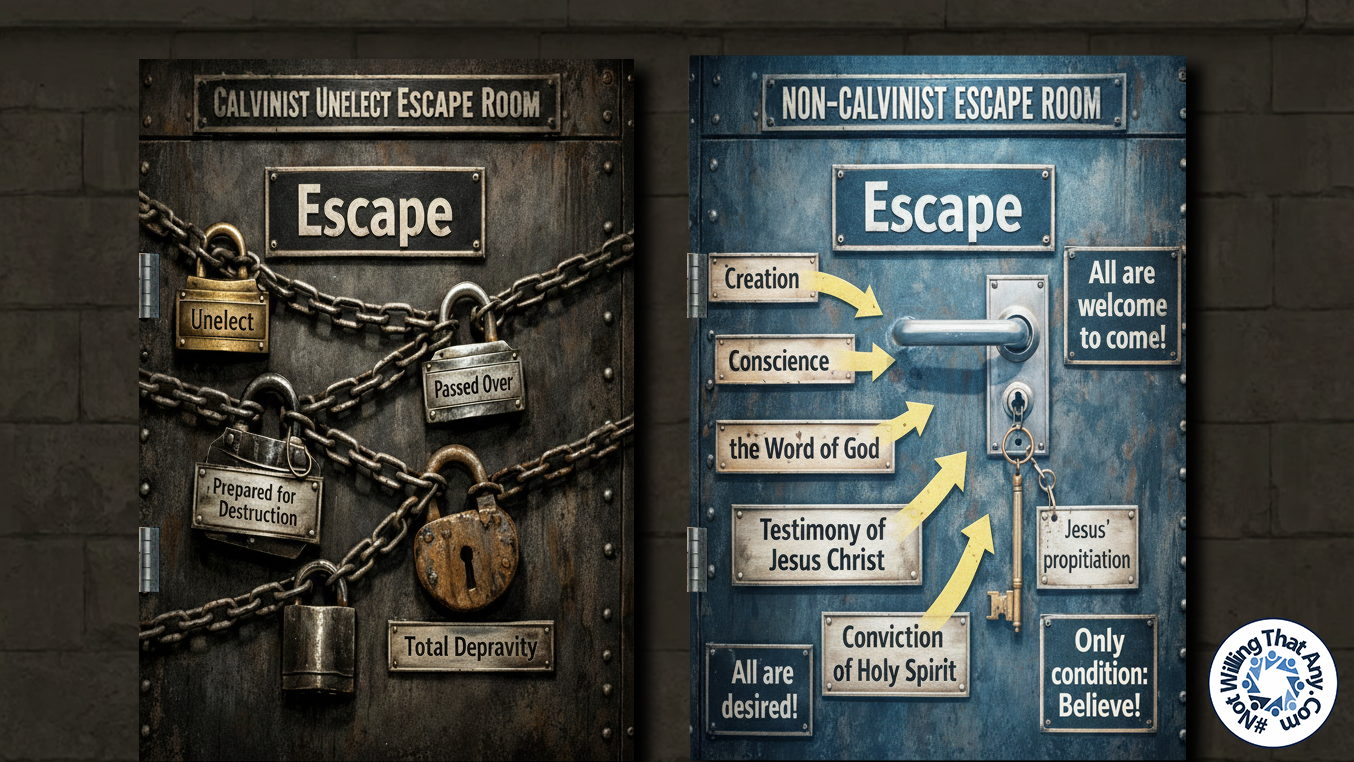
The image draws a sharp contrast between two ways of framing the gospel offer. On the Calvinist door, “escape” is named but functionally inaccessible because the conditions attached to the person also guarantee the impossibility of leaving. On the non Calvinist door, the handle is real, the key is present, and God’s revelation through creation, conscience, the Word, Christ, and the Spirit genuinely points toward a response. The point is not salvation by effort, but coherence. A rescue that is offered yet unreachable feels hollow, while an escape that can be entered through belief makes the invitation intelligible.
Is it an accurate picture of Calvinism?
Most Calvinists will immediately say the door is not locked by God but by our own sin. That clarification matters and it deserves to be stated plainly. In Calvinist theology, humanity freely sins according to its nature, and that sinful nature is what bars the way to God. Yet the illustration is intentionally framed from the experience of the unelect person inside the room. On Calvinism, that person is totally depraved, morally unable to turn to God, and incapable of responding positively to the gospel apart from regenerating grace. If God had chosen differently, that same person could have turned and would have turned. From within the system, the impossibility is real, not hypothetical. The door is locked by sin, but sin itself is decisive because God has chosen not to overcome it in that individual. The image is not denying Calvinist explanations, it is translating them into lived perspective.
Moral Inability: Calvinism teaches that fallen humans are not merely unwilling but unable to come to God apart from grace (John 6:44; Romans 8:7–8). The locked door represents this inability. The unelect person cannot open it, not because the gospel lacks clarity, but because their nature prevents a positive response.
Conditional Capacity: On Calvinism, the difference between those who believe and those who do not is not found in the individual but in God’s electing choice (Romans 9:11–16). If God had elected the unelect person, their inability would have been overcome. The illustration reflects this by showing that escape is possible only if something external changes first.
Means Without Effect: Calvinists affirm that the gospel, creation, and conscience are real means of revelation (Romans 1:18–20; 2 Corinthians 5:20). Yet they also hold that these means are not sufficient to enable belief in the unelect. The escape sign is visible, but visibility alone does not grant access.
Regeneration Order: Faith follows regeneration in Calvinist theology, not the other way around (Ephesians 2:1–5). The illustration mirrors this order by showing no functional handle until divine action occurs. The unelect person is not refusing a handle they see, but lacking one altogether.
System Coherence: Internally, the system is consistent. Total depravity requires irresistible grace, and particular election explains why some receive it and others do not. The illustration does not accuse Calvinism of contradiction. It asks whether the resulting picture aligns with the plain sense of invitation language found in Scripture.
So the real question is not whether Calvinism can explain the locked door, but whether this is a faithful picture of what Calvinism actually teaches when viewed from the ground level. If this is an accurate portrayal of the unelect condition within Calvinist theology, is it a picture you find compelling and true to the gospel’s call to come?