
Quick Take:
What happens when every form of revelation is acknowledged as true, yet treated as insufficient to persuade or convict on its own?
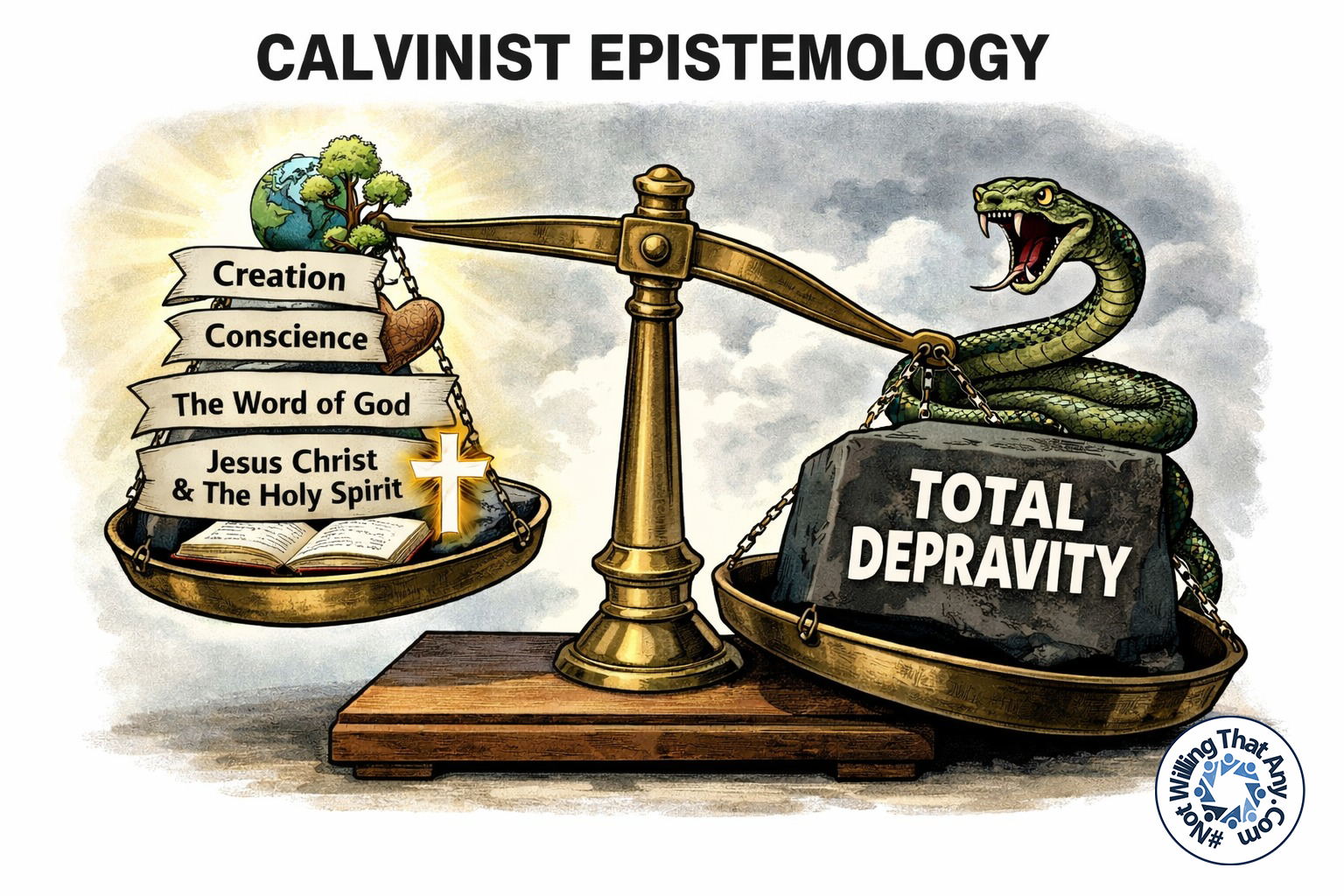
This illustration highlights a tension within Calvinist epistemology where creation, conscience, Scripture, Christ, and even the external work of the Holy Spirit are affirmed as genuine sources of truth, yet are portrayed as outweighed by total depravity. The scale suggests that human sinfulness does not merely distort understanding but overwhelms every avenue by which God reveals Himself, leaving revelation informative but non decisive unless an additional internal act intervenes. The concern this raises is whether revelation, as Scripture presents it, is meant to function primarily as witness and invitation or merely as background information awaiting regeneration. If truth must correspond to reality, the image presses whether a system that consistently renders God’s self disclosure powerless to convince can still claim to be doing justice to the way God says He makes Himself known.
Is it an accurate picture of Calvinism?
The aim of this illustration is accuracy rather than exaggeration. It asks whether the image faithfully reflects how Calvinist theology understands knowledge of God, revelation, and human inability when its doctrines are held together. The question is not whether the picture is flattering, but whether it matches the system’s own claims.
Total Depravity: Calvinism teaches that sin affects every faculty of human nature, including the mind, rendering people unable to rightly understand or respond to God apart from grace. The weight labeled total depravity accurately represents the claim that human fallenness overwhelms natural and spiritual perception (Romans 1:21–23; Romans 8:7–8; 1 Corinthians 2:14).
Revelation Affirmed: Calvinism affirms that God genuinely reveals Himself through creation, conscience, Scripture, Christ, and the Spirit. These forms of revelation are true, authoritative, and sufficient in content, even if not sufficient in effect (Psalm 19:1–4; Romans 1:18–20; Hebrews 1:1–2). The image reflects this by including all recognized means of revelation on the scale.
Efficacy Denied Apart from Grace: While revelation is affirmed as real, Calvinism denies that it can produce saving knowledge on its own. Apart from regeneration, revelation informs and condemns but does not persuade or convert. The scale tipping toward depravity captures this non decisiveness (John 6:44; John 12:37–40).
Regeneration Priority: In Calvinist theology, the ability to truly know God savingly comes only after the heart and mind are renewed. Illumination follows regeneration rather than preceding it. The illustration reflects this order by showing revelation outweighed until depravity is removed (Ephesians 2:1–5; 2 Corinthians 4:6).
Judicial Function of Revelation: Calvinism often understands revelation as serving a judicial role for the unregenerate. It leaves people without excuse rather than enabling belief. The image reflects this by portraying revelation as present but ineffective in changing the balance (Romans 1:20; John 9:39).
Taken together, the illustration does not deny that Calvinists believe in revelation, nor does it suggest they think God’s self disclosure is false or insincere. It accurately depicts a framework in which total depravity renders every form of revelation non decisive unless accompanied by regenerating grace.
The question left for consideration is whether a system that consistently portrays God’s own revelation as outweighed by human sinfulness offers an account of knowledge that truly corresponds to how Scripture says God makes Himself known.