
Quick Take:
Is it an accurate picture of Calvinism?
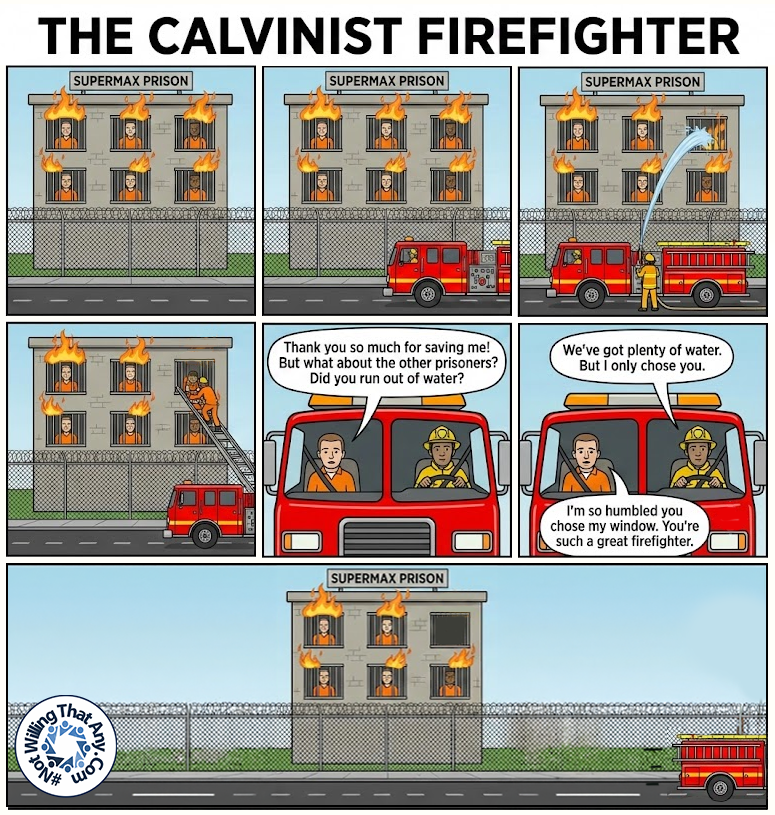
The aim of this illustration is accuracy, not mockery. It is intended to engage Calvinist theology on its own terms rather than caricature it. A meaningful critique must begin by representing Calvinism as its advocates themselves describe it, allowing the system to be evaluated based on its actual claims.
Total Inability: The prisoners are entirely unable to rescue themselves from the fire, reflecting the Calvinist teaching that fallen humanity is spiritually dead and incapable of coming to God apart from divine intervention (Ephesians 2:1–3; Romans 8:7–8).
Sovereign Election: The firefighter chooses whom to rescue based solely on his own decision rather than any quality, action, or response found in the prisoners. This mirrors unconditional election, where God’s saving choice rests in His sovereign will alone (Romans 9:15–16; Ephesians 1:4–5).
Effectual Grace: The rescue of the chosen prisoner is decisive and successful. Once the firefighter acts, the outcome is guaranteed, reflecting the Calvinist claim that God’s saving grace unfailingly accomplishes salvation for those He intends to save (John 6:37; John 6:44).
Particular Redemption: The firefighter’s efforts are directed toward one individual rather than all those in danger. This aligns with the doctrine of particular redemption, where Christ’s atoning work is understood to be designed to secure salvation for the elect in a definite and effective way (John 10:11, 15; Matthew 1:21).
God-Centered Glory: The rescued prisoner responds with gratitude that highlights the rescuer’s choice and action rather than questioning the scope of the rescue. This reflects the Calvinist emphasis that salvation ultimately exists to magnify God’s glory and initiative rather than human response or cooperation (Ephesians 1:5–6; Romans 11:36).
Taken together, these elements show that the illustration is engaging real Calvinist theology rather than a strawman. It portrays a system in which salvation is entirely God-driven, selective by divine purpose, and effectual for those chosen.
The question that remains is not whether the illustration is fair, but whether this portrayal of salvation is one you believe best reflects the character of God revealed in Scripture?