
Quick Take:
What follows if a person’s eternal destiny is settled before they ever have a real opportunity to choose otherwise?
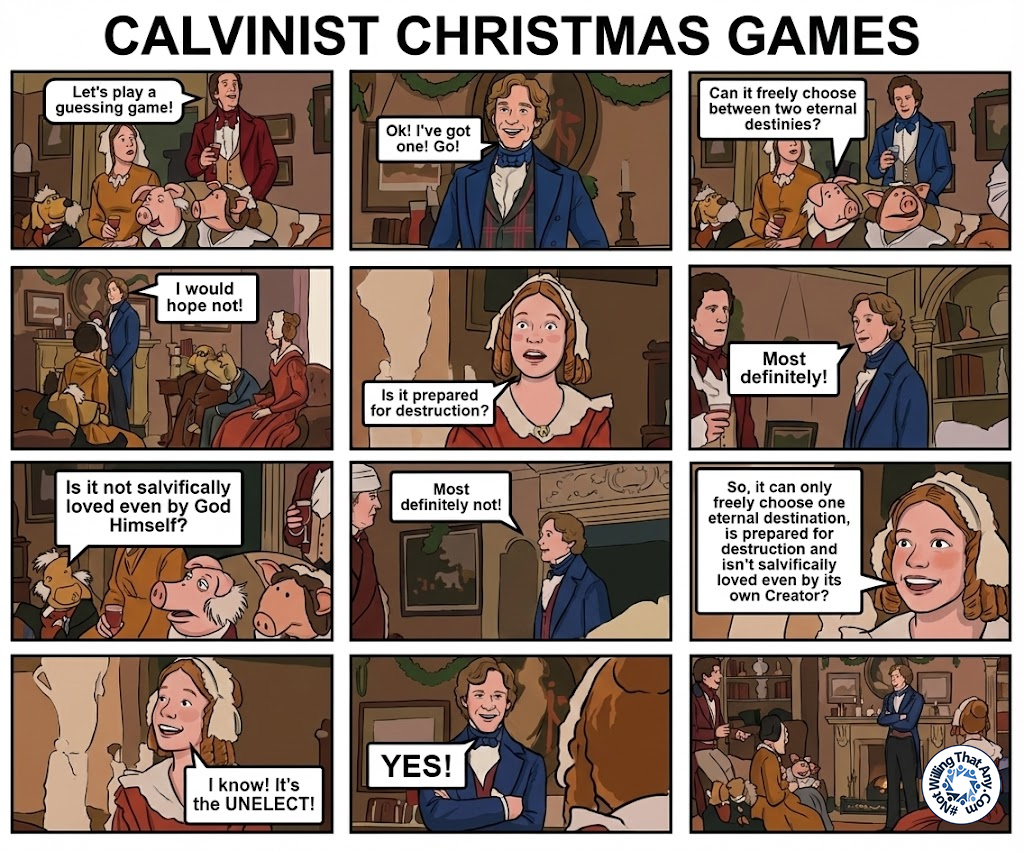
This illustration presses a tension that arises from Calvinism’s core commitments. If only some people are eternally chosen, then others are understood to exist without a real ability to choose between salvation and condemnation. Those not chosen are viewed as destined for destruction and not loved by God in a saving sense, even though they are His creatures. The concern is that this framework fixes the final outcome prior to any response, raising serious questions about God’s love, justice, and the sincerity of His universal call to repent. Scripture consistently portrays God as loving the world (John 3:16), desiring all people to be saved (1 Timothy 2:4), taking no pleasure in the death of the wicked (Ezekiel 18:23; Ezekiel 33:11), and genuinely calling people to choose life (Deuteronomy 30:19; Acts 17:30). The central tension, then, is whether a system that concludes with some people being “unelect” and prepared for destruction can be squared with the Bible’s repeated presentation of God’s universal love and earnest invitation to all.
Is it an accurate picture of Calvinism?
The purpose of this illustration is accuracy rather than satire. It is meant to reflect how Calvinist theology frames human ability, divine love, and eternal destiny when its doctrines are applied consistently. The issue is not whether the scene feels sharp, but whether it mirrors the system’s own claims.
Total Depravity: The assumption that the person cannot freely choose between two eternal destinies reflects the Calvinist belief that fallen humanity lacks the moral ability to desire or choose God apart from grace. The human will is viewed as bound by sin rather than neutral or self-determining (Romans 3:10–12; Romans 8:7–8; John 6:44; 1 Corinthians 2:14).
Unconditional Election: The discussion moves toward identifying a fixed category rather than an open outcome. Salvation is treated as settled by God’s prior choice, not contingent on human response or foreseen faith (Romans 9:11–16; Ephesians 1:4–5; 2 Timothy 1:9).
Particular Redemption: The claim that the person is not salvifically loved by God reflects the Calvinist distinction between God’s general benevolence and His saving love. Christ’s atoning work is understood to be designed to secure salvation only for the elect (John 10:11, 15; Matthew 1:21; Ephesians 5:25).
Irresistible Grace: The logic of the exchange assumes that if saving grace were given, salvation would certainly follow. Grace is not merely enabling but effectual, unfailingly producing repentance and faith in those to whom it is granted (John 6:37; John 6:44; Acts 13:48).
Sovereign Determination: The conclusion treats the person’s eternal destiny as settled rather than contingent. God’s eternal decree functions as the ultimate explanation for salvation or judgment, standing behind all outcomes (Romans 9:18–21; Daniel 4:35; Proverbs 16:4).
Taken together, the illustration does not invent these doctrines or exaggerate their implications. It visualizes how Calvinist theology speaks about inability, election, love, grace, and destiny when those claims are allowed to stand together.
The question left on the table is this: if this is a faithful representation of Calvinist theology, is this the account of salvation you find biblically compelling?