
Quick Take:
In discussions around earlier illustrations, many Calvinists objected that those in danger would not actually be seeking to be saved. They argued that sinners love their sin so much that they would reject God’s offer of salvation and even desire hell. I have never understood why this would change anything in the larger Calvinist framework, since God, through His elective power, would regenerate those individuals regardless of their sinful or hostile posture prior to His effectual call.
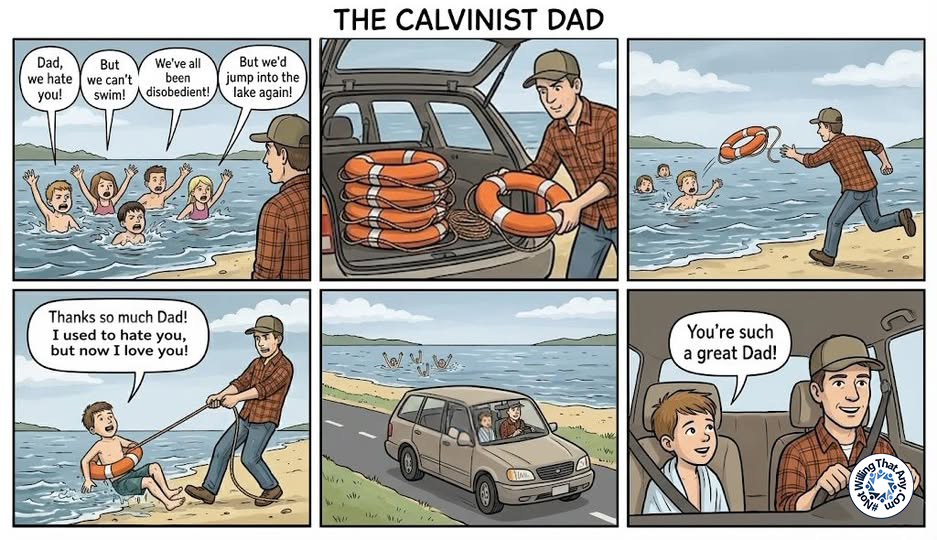
Still, in an effort to fully represent the idea of total depravity, I tried to make it clear that those in danger would continue in their rebellion. That is why I included four separate speech bubbles in Panel 1. Yet even after posting the illustration, some Calvinists still argued that the main problem was that the children were calling out for help, insisting that truly depraved sinners would never do that.
The Breakdown:
Panel 1:
This panel was meant to show that the children are totally depraved. They explicitly tell their father that they hate him. I also wanted to clearly establish their danger, so one speech bubble explains that they cannot swim and are going to drown. The third speech bubble, though short, is meant to show that their situation is the result of their own disobedience. The final speech bubble indicates that if given the chance, they would do the exact same thing again.
Panel 2:
Here the father runs to his vehicle, which contains enough lifesavers to rescue all of the drowning children. However, he chooses only one. These lifesavers represent the atonement accomplished by Christ on the cross. I briefly considered showing only a single lifesaver, but I thought many Calvinists would argue that the atonement is sufficient for all and effective only for those God intends. For that reason, I left multiple lifesavers in the illustration.
Panels 3 and 4:
In these panels, the father throws a lifesaver and rescues one child. Originally, I had a longer speech bubble here, but I wanted to make one point very clear: the child’s heart is regenerated as he is being saved. Within Calvinism, particularly the doctrine of total depravity, the human heart is so corrupt and hostile toward God that it cannot respond positively to the gospel. Only after regeneration does the person come to love God. Most Calvinists would say this change is not forced, but happens in harmony with the will once it has been renewed.
Panel 5:
This panel shows the remaining children drowning. They are spiritually dead, as shown earlier, and now they become physically dead as well. They are receiving what is understood to be the just penalty for their sin.
Panel 6:
This final panel reflects a common Calvinist response: gratitude for God’s mercy toward themselves, paired with the belief that God must also display His wrath toward those prepared for destruction. Still, when the scene is visualized this way, it seems natural that the rescued child would at least wonder why the others were not saved. It is also unsettling that the father, who clearly had the ability to save all the children, receives praise from the saved child without any visible concern for those left behind.